
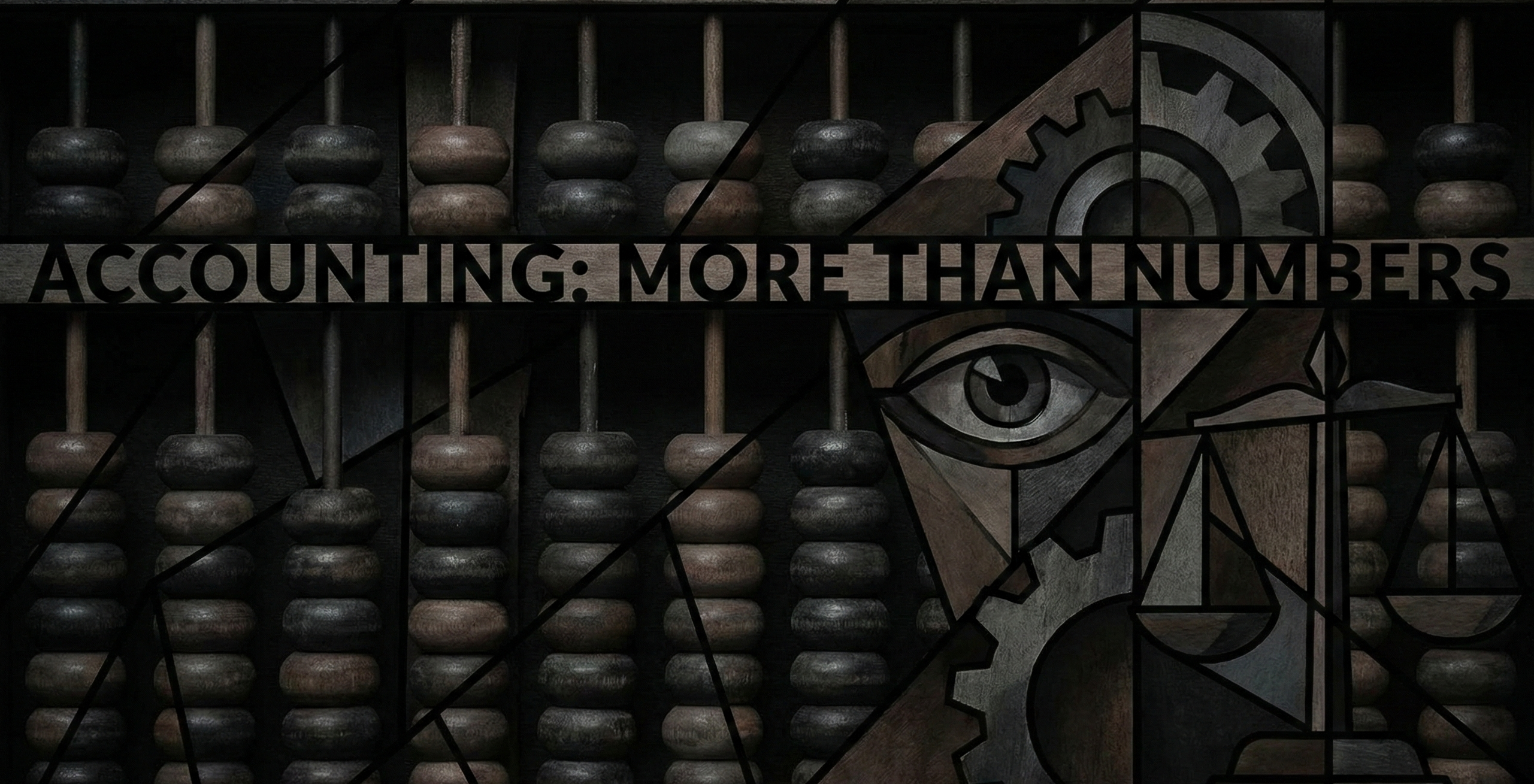
Your Accountant Is an Abacus Operator. You Need a Storyteller.
The abacus is a museum piece. So is your ledger.
For too long, we’ve worshipped at the altar of the balanced sheet. A perfect, sterile, and utterly misleading representation of reality. We’ve been taught that accounting is about looking backward. About recording history. About making sure the columns add up. We treat it as a sacred text, a book of immutable truths. But it’s not. It’s a story, and a poorly written one at that.
This is a lie.
A comfortable, profitable lie for some. But a lie nonetheless.
Traditional accounting is a rearview mirror on a car hurtling towards a cliff. It tells you, with perfect precision, the exact moment you went off the road. It doesn’t, however, tell you how to steer. It’s a history lesson when what you need is a weather forecast. It’s a post-mortem when you need a diagnosis.
It’s time for a revolution. Not a quiet, polite, behind-the-scenes revolution. A loud, messy, and glorious one. It’s time to stop being accountants and start being artists, scientists, and revolutionaries. It’s time to burn the ledger, metaphorically of course, and write a new story.
It’s time for accounting for the bold.
The Mediocrity Tax in Your Books
You’re already paying it. You just don’t see it on your P&L. It’s the Mediocrity Tax. The silent killer of businesses. The tax on “good enough.” It’s the insidious creep of irrelevance, the slow fade to black.
In accounting, the Mediocrity Tax looks like this:
- Lost opportunities you never even saw. Because your financial reports are a month late and a dollar short. By the time you see the trend, the trend is over. The ship has sailed, and you’re still counting the barnacles on the dock. You’re celebrating last year’s victory while your competitor is colonising a new market.
- Good people who silently leave. The brilliant analyst who’s tired of spending her days exporting data to Excel. The visionary leader who can’t get the insights he needs to make a bold move. They don’t slam the door. They just fade away, taking their talent and their ideas with them. They leave for a place where their work matters, where they can make a difference, not just fill out a spreadsheet.
- Profits that evaporate despite increasing revenue. You’re bailing water with a teaspoon, wondering why the boat is still sinking. Your accounting system is the leak, hidden beneath the floorboards of outdated processes and disconnected data. You’re so focused on the top line that you’ve ignored the rot in the foundation.
- Market share that slips away while you’re “getting by.” Your competitors aren’t just playing the game better; they’re playing a different game altogether. And your accounting system is still keeping score for the old one, a game that no one is playing anymore. You’re bringing a knife to a gunfight, and you’re proud of how sharp your knife is.
This isn’t about fraud. It’s not about incompetence. It’s about a fundamental misunderstanding of what accounting is for. It’s about clinging to the past in a world that is hurtling into the future.
The Broken Triangle of Accounting
Most businesses are built on a one-legged stool. They pour all their energy into one thing, hoping it will be enough. In accounting, that one leg is Financial Intelligence.
We track every penny. We build complex models. We generate beautiful reports. But we do it in a vacuum. We create a pristine, sterile bubble of numbers that has no connection to the messy, chaotic reality of the real world.
We hire great people into broken systems. We build systems without a soul. We track numbers without a story. We create a factory of reports that no one reads, a library of data that no one understands.
This is the partial solution trap. The myth of the single silver bullet. “If we just had better financial control…”
Physics disagrees. A three-legged stool needs all three legs to be stable. The same is true for your business. A business is a complex, living organism, not a machine. It needs balance, harmony, and a connection to the world around it.
The Triangular Advantage OS for Accounting
It’s time to upgrade your operating system. To move from the abacus to AI. To move from the ledger to a living, breathing ecosystem of intelligence.
Welcome to the Triangular Advantage OS.
This isn’t a new piece of software. It’s a new way of seeing. A new way of thinking. A new way of leading. It’s a philosophy, a mindset, a commitment to excellence.
It’s built on three pillars that must rise in symmetry:
People & Culture (HLTC): From Bean Counters to Financial Storytellers
Your accounting team is not a cost centre. It’s the heart of your business. The storytellers. The truth-tellers. They are the guardians of your financial narrative, the interpreters of your economic soul.
Stop hiring for compliance. Start hiring for curiosity. For courage. For the ability to see the story behind the numbers. Hire people who ask “why” five times. Hire people who would rather break a rule than break a promise. Hire people who see a spreadsheet as a canvas, not a cage.
Invest in their growth. Not just in the latest accounting standards, but in data science, in communication, in leadership. Give them the tools and the freedom to be more than just number crunchers. Send them to design thinking workshops. Encourage them to take improv classes. Give them a subscription to a philosophy podcast. You’re not just building a better accounting team; you’re building better thinkers.
Create a culture of psychological safety where they can challenge the status quo. Where they can say, “This number doesn’t make sense.” Where they can be the first to spot the iceberg on the horizon. A culture where failure is not a fireable offense, but a learning opportunity. A culture where the most junior analyst can challenge the CFO, and be celebrated for it.
Processes & Systems (MAPS): From Spreadsheets to Intelligent Systems
Your accounting system is not a database. It’s a nervous system. It should be alive, responsive, and intelligent. It should be the central nervous system of your entire organisation, sensing, processing, and responding to information in real-time.
If you’re still closing your books manually, you’re already behind. If you’re still using spreadsheets as your primary tool for analysis, you’re flying blind. You’re navigating a Formula 1 race with a map from the 19th century.
Automation is not about replacing people. It’s about liberating them. It’s about freeing them from the drudgery of repetitive tasks so they can focus on what matters: insight, strategy, and action. It’s about giving them the time and space to be human, creative, and brilliant.
Your systems should be integrated. Your CRM should talk to your ERP. Your sales data should flow seamlessly into your financial forecasts. There should be one source of truth, not a dozen conflicting spreadsheets. A single, unified view of the business that is accessible to everyone, from the CEO to the summer intern.
Business Intelligence & Stakeholder Insights: From Financials to a 360-Degree View
Your P&L is not the whole story. It’s not even the most crucial part of the story. It’s a single chapter in a sprawling, epic novel.
The boldest accounting strategies look beyond the financials. They embrace a holistic view of the business, incorporating insights from every corner of the organisation and beyond.
Customer data: What are your customers telling you with their clicks, their purchases, their complaints? How does that translate into future revenue? Are you tracking customer lifetime value? Net promoter score? Churn rate? Are you using this data to build better products, better services, better relationships?
Employee data: Are your people engaged? Are they learning? Are they growing? How does that impact productivity and innovation? Are you tracking employee satisfaction? Turnover? Time to promotion? Are you using this data to build a culture that attracts and retains the best talent?
Market data: What are your competitors doing? What are the macro trends that will shape your future? How are you positioned to win? Are you tracking market share? Share of voice? Customer sentiment? Are you using this data to anticipate the future and create it?
This isn’t about more data. It’s about the right data. It’s about connecting the dots. It’s about seeing the patterns that no one else sees. It’s about turning data into information, information into insight, and insight into wisdom.
The Bolt-On Dimensions: The Five Frontiers of Bold Accounting
But the triangle is just the beginning. To truly revolutionise your books, you need to push the boundaries even further. You need to embrace the five bolt-on dimensions of the Triangular Advantage OS:
Customer & Stakeholder Experience: Accounting with Empathy
How does your accounting impact your customers? Does your invoicing process create friction? Does your collection process destroy relationships? Or are you designing every financial touchpoint to build trust and loyalty? Your invoice is a love letter or a Dear John letter. Your collection call is a conversation or a confrontation. You choose.
Your accounting team should be obsessed with the customer experience. They should be using data to understand customer behaviour, to identify pain points, and to design solutions that create delight. They should be working with the product team, the marketing team, the sales team, to create a seamless, frictionless customer journey.
Innovation & Learning Culture: Accounting as a Catalyst for Growth
Traditional accounting is the enemy of innovation. It’s risk-averse. It’s backward-looking. It’s focused on protecting the status quo. It’s the department of “no.” The place where dreams go to die.
Bold accounting is different. It’s a catalyst for growth. It’s about creating the space for experimentation. It’s about funding the crazy ideas that just might change the world. It’s about saying “yes, and…” instead of “no, because…”
It’s about measuring what matters, not just what’s easy to measure. It’s about tracking the ROI of your innovation portfolio, not just the cost of your R&D department. It’s about understanding that the biggest risk is not taking any risks at all.
Sustainability & Social Responsibility: The New Bottom Line
The world has changed. The old definition of the bottom line is no longer enough. Your stakeholders—your customers, your employees, your investors, your community—are demanding more.
They want to know that you’re not just making a profit, but that you’re making a difference. They want to know that you’re a good steward of the environment. That you’re a responsible corporate citizen. That you’re building a better world.
Bold accounting embraces this new reality. It’s about measuring your impact on people and the planet, not just your profit. It’s about integrating ESG (Environmental, Social, and Governance) metrics into the core of your financial reporting. It’s about understanding that long-term value creation is impossible without a healthy planet and a just society.
Risk Management & Resilience: Seeing Around Corners
The future is uncertain. Disruption is the new normal. The only thing we can be sure of is that the unexpected will happen.
Traditional accounting is not equipped to deal with this level of uncertainty. It’s too slow. It’s too rigid. It’s too focused on the past.
Bold accounting is about building resilience. It’s about seeing around corners. It’s about using data and scenario planning to anticipate and mitigate risks before they become crises. It’s about building a business that is antifragile, a business that gets stronger in the face of adversity.
It’s about building a business that can not only survive the storm, but thrive in it.
Digital & Data Transformation: The Engine of the New Accounting
This is the engine that powers it all. The digital and data transformation is not a project. It’s not a department. It’s a fundamental rewiring of your entire organisation.
It’s about embracing the cloud, AI, and machine learning. It’s about building a data-driven culture. It’s about empowering every employee with the tools and the skills they need to turn data into insight and insight into action. It’s about creating a virtuous cycle of continuous improvement, where every action generates data, and every data point informs the next action.
The Bold Accountant’s Manifesto
This isn’t a job for the faint of heart. It’s a calling for the brave, the curious, and the restless. It’s a commitment to a new way of being, a new way of working. Here is the manifesto for the bold accountant:
- We are storytellers, not just scribes. We don’t just record the past; we illuminate the future. We find the narrative in the numbers, the drama in the data.
- We are partners, not police. We don’t just enforce the rules; we empower our colleagues to make better decisions. We are coaches, not critics.
- We are innovators, not inhibitors. We don’t just protect the status quo; we challenge it. We are constantly searching for a better way, a smarter way, a faster way.
- We are learners, not know-it-alls. We don’t have all the answers, but we are always asking the right questions. We are humble, curious, and open to new ideas.
- We are leaders, not followers. We don’t just follow the herd; we chart our own course. We are the first to see the future, the first to embrace it, the first to create it.
A Tale of Two Companies
Imagine two companies. Both are in the same industry, with similar products and similar markets. Both are facing the same headwinds of disruption and uncertainty.
Traditional accountants run company A. They are meticulous, precise, and utterly predictable. Their books are a work of art, a testament to their diligence. But they are always looking backward. They are always fighting yesterday’s battles. They are so focused on the details that they miss the big picture. They are slowly, inexorably, becoming irrelevant.
Bold accountants run company B. They are messy, creative, and utterly unpredictable. Their books are not a work of art; they are a work in progress. They are a living, breathing document that is constantly evolving. They are always looking forward. They are always fighting tomorrow’s battles. They are so focused on the big picture that they are creating the future. They are not just surviving; they are thriving.
Which company do you want to be?
The Choice is Yours
You can continue to play the old game. To worship at the altar of the balanced sheet. To be a historian of your business.
Or you can choose a different path. A bolder path.
You can choose to be a revolutionary. To be an artist. To be a scientist.
You can choose to build a business that is not just profitable, but resilient, innovative, and sustainable.
You can choose to build a business that is not just good enough, but truly excellent.
The choice is yours. The time is now.
What will you choose?