
Business Model Canvas: Business Architecture Design & Ideation
Step 1: Business Model Canvas Audit We dissect all nine blocks with uncomfortable precision:
- Customer Segments: Who actually pays you (not who you wish would)
- Value Propositions: What customers experience (not what you deliver)
- Channels: How value flows (including where it gets stuck)
- Customer Relationships: The actual experience (not the intended one)
- Revenue Streams: What generates margin (not just revenue)
- Key Resources: What’s truly scarce (beyond the obvious answers)
- Key Activities: What drives 80% of results (versus what consumes 80% of time)
- Key Partnerships: Who multiplies capability (versus who just bills hours)
- Cost Structure: What creates versus destroys value
The Painful Questions:
- Which blocks are built on heroic effort rather than systematic capability?
- Where do we mistake activity for impact?
- What would break first at 3x current volume?
Automation: Converting Heroics to Systems
Step 2: Process Automation Roadmap We identify the few critical processes that drive the majority of results and then systematically eliminate variation.
- Document current best practice (even if imperfect)
- Eliminate unnecessary complexity (most of it is)
- Automate repetitive decisions (free cognitive bandwidth for strategy)
- Build quality into the process (rather than inspecting it later).
- Create feedback loops (that improve the system automatically)
The Brutal Truth: If you can’t document it, you can’t scale it. If you can’t automate it, you can’t sustain it.
Processes: Operational Excellence Engineering
Step 3: Triangle Process Integration We don’t just optimise individual processes—we engineer the connections between Human Capital, Systems, and Financial Intelligence:
- Knowledge Flow: How expertise moves from individual minds into organisational systems
- Decision Velocity: How quickly good choices get made and implemented
- Quality Assurance: How excellence becomes automatic rather than exceptional
- Performance Transparency: How everyone knows the score in real-time
- Continuous Improvement: How the system gets better without heroic intervention
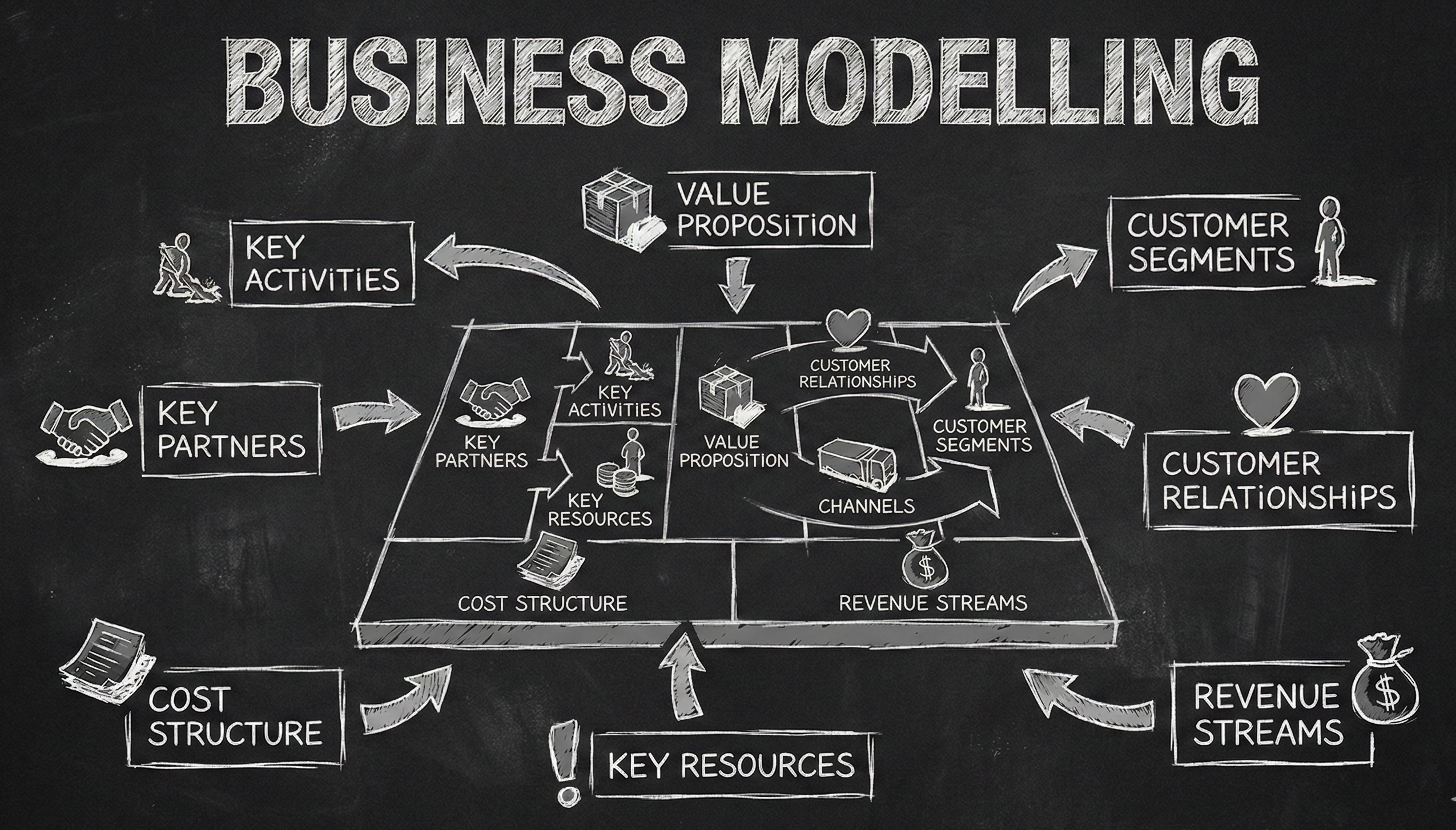
Business Model Canvas
Systems: The Compound Effect
Step 4: Systematic Capability Building Real business modelling isn’t a one-time exercise—it’s an evolving discipline:
- 90-day improvement cycles that compound capability
- Measurement systems that make performance objective
- Knowledge capture protocols that prevent organisational amnesia
- Decision frameworks that distribute strategic thinking
- Resource allocation processes that fund growth, not just maintenance
“Traditional consulting optimizes your Business Model Canvas one block at a time—stronger Value Propositions here, better Channels there, lower Cost Structure somewhere else. But blocks don’t create competitive advantage; their multiplicative integration does. When Human Capital Intelligence strengthens your Key Resources, Systems Intelligence scales your Key Activities, and Financial Intelligence optimizes your Cost Structure simultaneously, you don’t improve your business model—you architect compound superiority that competitors can’t reverse-engineer.”
The Transformation Blueprint
Phase 1: Diagnostic Reality (Weeks 1-2)
Triangle Business Model Audit:
- Human Capital maturity assessment
- Systems integration analysis
- Financial intelligence evaluation
- Business Model Canvas deconstruction
- Competitive capability gap identification
Output: Brutally honest assessment of where you stand versus where you need to be
Phase 2: Architecture Design (Weeks 3-6)
MAPS Framework Development:
- Business model optimisation across all nine canvas blocks
- Process automation roadmap prioritising high-impact opportunities
- Knowledge capture and distribution systems design
- Financial dashboard and decision support frameworks
- 90-day implementation sprints with measurable milestones
Output: Systematic roadmap from current chaos to Triangle-integrated capability
Phase 3: Implementation Acceleration (Months 2-6)
Systematic Transformation:
- Core process documentation and optimization
- Automation implementation for repetitive decisions
- Knowledge management system deployment
- Financial intelligence dashboard activation
- Continuous improvement protocols establishment
Output: Measurable improvements in margin, velocity, and strategic capacity
Phase 4: Compound Capability (Months 6-12+)
The Multiplication Effect:
- Team capability development through systematic knowledge transfer
- Process refinement based on real-world feedback
- Financial model evolution as business scales
- Strategic initiative acceleration enabled by operational stability
- Competitive advantage compounding through systematic superiority
Output: Business that scales through architecture, not heroic effort
Stop the Theatre. Build the Architecture.
The choice is binary:
Option A: Continue the fiction. Treat business modelling as a documentation exercise. Hope that revenue growth somehow compensates for structural deficiencies. Pay the Mediocrity Tax in perpetuity.
Option B: Face reality. Build Triangle-integrated architecture. Create systematic capability that compounds. Convert your business from expensive improvisation to profitable machine.
The physics don’t negotiate. The market doesn’t compromise.
Your competitors are making the choice. The only question is whether you’ll do it from strength or desperation.
Your Next Move
1. Reality Check
Schedule a Triangle Business Model Diagnostic. 90 minutes. Zero sales pitch. Just brutal honesty about where your business model is structurally sound versus dangerously fragile.
2. Strategic Decision
Choose systematic transformation over continued chaos. Commit to building all three Triangle legs simultaneously—not incrementally, not eventually, but now.
3. Implementation Sprint
Launch your first 90-day MAPS cycle. Quick wins that create capability, not just relief. Measurable improvements that compound, not dissipate.
The cost of waiting doubles every quarter. The advantage of action compounds every month.