
The Big Rocks Are Laughing At Your Calendar
You’re Organising the Wrong Things
Here’s what most leaders do: They open their calendar app, block time for “strategic thinking,” schedule back-to-back meetings, color-code their priorities, and convince themselves they’re in control.
Then reality shows up.
The urgent drowns the important. The meeting about the meeting consumes the time allocated for actual work. The “quick question” becomes an hour. And those big, beautiful rocks—the things that actually matter—sit there, watching you scramble through sand.
Steven Covey wasn’t being poetic when he talked about big rocks. He was delivering a diagnosis. Most leaders are spending their days organizing gravel while mountains wait.
The jar is finite. Your life is finite. And you keep filling it with pebbles first.
The Uncomfortable Truth About Being Important
Let’s start with something that’ll make you squirm: You’re probably not as critical as you think you are.
That project that “only you can handle”? Someone else could probably do it at 80% of your quality in 40% of the time. That meeting you “have to attend”? Your absence might actually improve it.
But here’s the twist—there ARE things only you can do. Things where you’re genuinely irreplaceable. The question isn’t whether you’re important. The question is: Are you spending your irreplaceable self on irreplaceable work?
Because if you’re not, you’re committing the ultimate waste. Not of time. Of you.
The Big Rocks Don’t Negotiate
Your daughter’s soccer game happens at 4 PM on Tuesday.
Your son’s bedtime story happens at 8 PM tonight.
Your spouse’s need for your presence doesn’t reschedule because your inbox exploded.
The big rocks of life—the actual priorities that define whether you lived or merely existed—these don’t wait. They don’t send reminders. They don’t negotiate.
They just… pass.
“Work-life balance is a myth sold by people who haven’t figured out how to build a life worth living. You don’t need balance—you need integration. You don’t need separation—you need clarity. And you don’t need permission—you need the courage to place your big rocks first and let everything else fall where it may.”
And here’s what the busy-work industrial complex won’t tell you: Those moments you’re missing to “be important”? They’re making you less important where it actually counts.
Delegation Is Not What They Sold You
Everyone talks about delegation like it’s about getting things off your plate.
It’s not.
Real delegation—the kind that multiplies your impact—is about assigning both the outcome AND the authority to achieve it.
Most leaders practice what we should call “task-dumping”:
- “Do this spreadsheet”
- “Handle this email”
- “Write this report”
- “Fix this problem (but check with me first)”
That’s not delegation. That’s outsourcing your to-do list while keeping the decision-making, the responsibility, and the stress.
True delegation looks different:
• Outcome: “We need to increase customer retention by 15% this quarter” • Authority: “You own this. Design the approach, allocate the resources, make it happen” • Accountability: “Show me the results and what you learned”
Notice what’s missing? Your hovering. Your micro-decisions. Your bottleneck.
The Delegation Paradox
Here’s the uncomfortable part: The only way to know if someone can handle something is to let them handle it. Including the stumbles. Including the failures.
You can’t delegate responsibility while clutching control. That’s not delegation—that’s puppeteering with extra steps.
The leader who can’t delegate isn’t protecting their business. They’re strangling it.
The Work-Life Separation Myth Is Killing You
Someone convinced you that “work-life balance” meant drawing bright lines between your professional and personal selves.
They lied.
Or at least, they oversimplified to the point of uselessness.
Because here’s what actually happens when you treat work and life as separate buckets:
- You feel guilty at work for not being home
- You feel guilty at home for not working
- You excel at neither because you’re half-present at both
- You create an artificial tension that shouldn’t exist
Integration, Not Separation
The leaders who actually thrive don’t separate work and life. They integrate them.
They ask different questions:
❌ “How do I balance work and family?”
✅ “How do I design a life where my work enhances my family and my family enhances my work?”
❌ “Should I attend this business dinner or my kid’s recital?”
✅ “What are my non-negotiable big rocks, and how does everything else arrange around them?”
❌ “Am I working to live or living to work?”
✅ “Am I building a life worth living, where work is one integrated part of my identity?”
Look, business commitments matter. They’re fuel for life. They’re how you contribute, create value, and yes—how you provide for the people you love.
But business is a servant, not a master.
When did you forget that?
Who’s Really Best for Your Most Important Job?
Here’s where it gets personal.
Pop quiz: Who’s the best person to be present at your kid’s big moment?
You.
Who’s the best person to show your spouse they matter more than your phone?
You.
Who’s the best person to build memories that’ll matter in thirty years?
You.
And yet… how often does “the best person for the job” disappear behind “I’m the only one who can handle this crisis”?
The Irreplaceable Work Matrix
Let’s get tactical. Draw four quadrants:
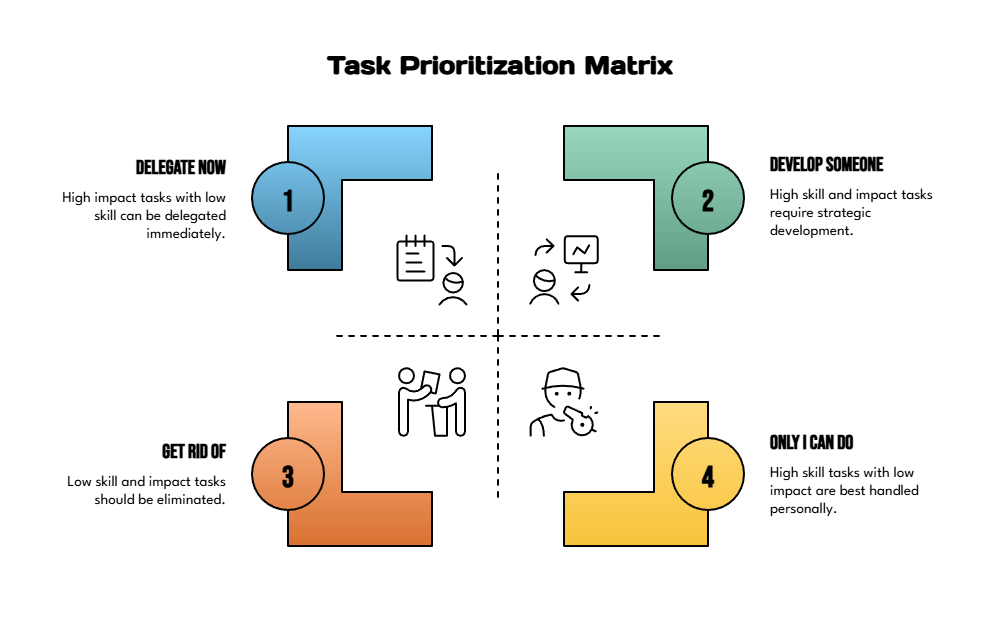
Task Prioritisation Matrix
Most of your day falls into “Develop Someone” or “Delegate Now.”
But you’re spending it in “Get Rid Of” because you haven’t said no.
And “Only I Can Do”? That’s mostly:
- Being a parent to YOUR children
- Being a partner to YOUR spouse
- Being present for YOUR one precious life
Everything else? Someone else can probably do it. Maybe not perfectly. But “perfectly” is often the enemy of “importantly.”
The Reality That Hunts You Down
You can ignore your big rocks.
You can fill your jar with sand and pebbles and convincing yourself you’re “being productive.”
You can keep saying “someday” and “when things calm down” and “after this busy season.”
But reality doesn’t negotiate either.
“The way we spend our days is, of course, the way we spend our lives.” — Annie Dillard
Every day you organize gravel instead of placing rocks is a day your life looks exactly like everyone else’s—busy, distracted, and somehow both too full and completely empty.
Your kids will grow up. Your spouse will either feel cherished or neglected. Your health will either thank you or betray you. Your best years will either be filled with presence or regret.
And nobody—nobody—lies on their deathbed wishing they’d attended more meetings about meetings.
The Big Rocks Don’t Wait for Permission
Here’s your permission slip: You don’t need one.
You don’t need your boss to approve your priorities.
You don’t need your industry to understand why you left early for the recital.
You don’t need anyone’s validation to decide that your spouse’s anniversary dinner is more important than that conference call.
You need to place the big rocks first. Everything else arranges around them.
Not the other way around.
The Practice: How Leaders Actually Do This
Stop talking about priorities. Start demonstrating them.
This week:
Identify your five big rocks (not twenty, not ten—five)
- What matters so much that twenty years from now, you’d regret missing it?
Block them in your calendar first (before meetings, before “flexibility,” before anything)
- Treat them like immovable appointments with the most important people in your world
Audit your actual time last week (not how you think you spent it, how you actually did)
- Where did the hours go? How many went to rocks vs. pebbles?
Identify three things to stop doing (not minimize, not “when time permits”—stop)
- What are you doing that someone else could do, should do, or shouldn’t be done at all?
Delegate one significant outcome (not a task, an outcome)
- Give someone the authority to own it. Resist the urge to hover. Let them surprise you.
The Choice Nobody Wants to Admit You Have
You have a choice.
Not between success and failure.
Not between work and life.
Not between ambition and presence.
The choice is simpler and harder: Will you organize your life around what matters, or around what’s urgent?
Because you can’t do both.
The urgent will always scream louder than the important. The pebbles will always try to fill the jar first. The meetings will always multiply. The inbox will always refill.
But your daughter will only be eight once.
Your son will only need that bedtime story for a few more years.
Your spouse will either feel chosen or convenient.
Your health will either sustain you or collapse.
The big rocks are laughing at your calendar because they know what you keep forgetting:
You can’t get time back. You can’t reschedule childhood. You can’t attend the same sunset twice.
The jar is finite.
Fill it with what matters.
Everything else is just gravel pretending to be important.
The question isn’t whether you’ll place your big rocks first. The question is whether you’ll do it before reality forces you to notice what you’ve been missing.