
The Attention Apocalypse (And Why You’re Part of the Problem)
Stop Trying To Get Attention. Start Deserving It.
Here’s something nobody in marketing wants to admit:
You’re not in the attention business anymore. You’re in the apology business.
Every day, you’re apologising for existing. Apologising for interrupting. Apologising for the crime of having something to say.
And the apology isn’t working.
The World Has a Chronic Condition
The world is suffering from Attention Deficit Disorder. Not the clinical kind. The structural kind.
The kind where 403 million terabytes of data get created every single day. The kind where your prospect gets interrupted every 3 minutes. The kind where it takes 23 minutes to recover from each interruption—but another one arrives in 3.
Do the math. Your customer is never recovered. They’re cognitively bankrupt. Running a permanent attention deficit.
And here’s the uncomfortable truth: You didn’t cause this problem. But you’re definitely making it worse.
Every email you send. Every banner you buy. Every “quick follow-up” you schedule. You’re adding to the debt, not paying it down.
The Six Horsemen of Attention Destruction
There are six reasons nobody’s listening to you. Not five. Not seven. Six structural forces grinding away at human focus like sandpaper on soap.
- The Paradox of Choice
Remember Sheena Iyengar’s jam study? Twenty-four varieties attracted browsers, while six varieties resulted in significantly more sales—ten times more, to be exact (Iyengar & Lepper, 2000).
The lesson: When you offer everything, you sell nothing. The rule: a confused mind doesn’t buy.
Your prospect isn’t choosing between you and your competitor. They’re choosing between you and the paralysing weight of infinite options. And paralysis is winning.
Choice isn’t freedom. It’s a tax.
- The Focus Myth
You’ve heard the goldfish statistic. Human attention span: 8 seconds. Goldfish: 9 seconds.
It’s nonsense.
Goldfish can learn tricks that take months to master. And humans can binge an entire season of television in one sitting. The problem isn’t that we can’t focus. It’s that we won’t focus on you.
“The goldfish myth is a comfortable lie. Your audience can focus for hours—on things that aren’t you. They’ll binge eight episodes, scroll for ninety minutes, game until sunrise. Attention isn’t scarce. Tolerance for your interruption is scarce. The problem was never their attention span. It’s your value proposition.”
The same teenager who “can’t concentrate” will spend six hours in a gaming session without blinking. Focus is not scarce. Tolerance for boredom is scarce.
Your content isn’t competing against short attention spans. It’s competing against everything else that’s more interesting than you.
- Advertising Pollution
There’s a debate about whether the average person sees 500 ads per day or 5,000. It doesn’t matter. The effect is the same: saturation sickness.
Banner blindness isn’t a glitch. It’s an immune response. The brain treats your message like background radiation.
Twenty-seven percent of internet users have installed ad blockers. Not because they hate your product. Because they’re protecting their cognitive space. You’re not a marketer anymore. You’re a pollutant.
- Information Overload
More than 90% of all the data ever created was created in the last two years.
Read that again.
Human evolution? Roughly the same pace it’s been for 50,000 years.
A study for Hewlett-Packard found that workers distracted by constant information suffered a 10-point IQ drop. That’s more than double the drop from smoking marijuana. Your customers aren’t stupid. They’re stoned on data.
The U.S. economy loses $1 trillion annually to information overload. Not a billion. Trillion. Twelve zeros of productivity vaporised because everyone’s drowning in input.
- Interruption Overload
Americans touch their phones 2,617 times per day. Half check their phones in the middle of the night.
Every interruption costs 23 minutes of recovery time. But interruptions arrive every 3-11 minutes. Your customer is living in a permanent state of cognitive whiplash.
“Your customer isn’t distracted. They’re defended. Every ad-blocker installed, every email unsubscribed, every notification muted is a brick in the wall they’re building against you. The question isn’t how to break through. It’s why they felt they needed a wall in the first place.”
Multitasking? A myth. The brain doesn’t do two things at once. It thrashes between them, like a computer with too many applications open. Productivity drops 40%. Stress hormones spike. And your carefully crafted message? It never gets encoded into long-term memory.
The impression counted. The attention was absent.
- Accelerating Technology
Martec’s Law: Technology changes exponentially. Humans change logarithmically.
The gap between those curves? That’s where all the disruption lives. That’s where your marketing playbook becomes obsolete before the ink dries.
AI can now generate infinite content at almost zero cost. Which means information overload and advertising pollution are about to get exponentially worse.
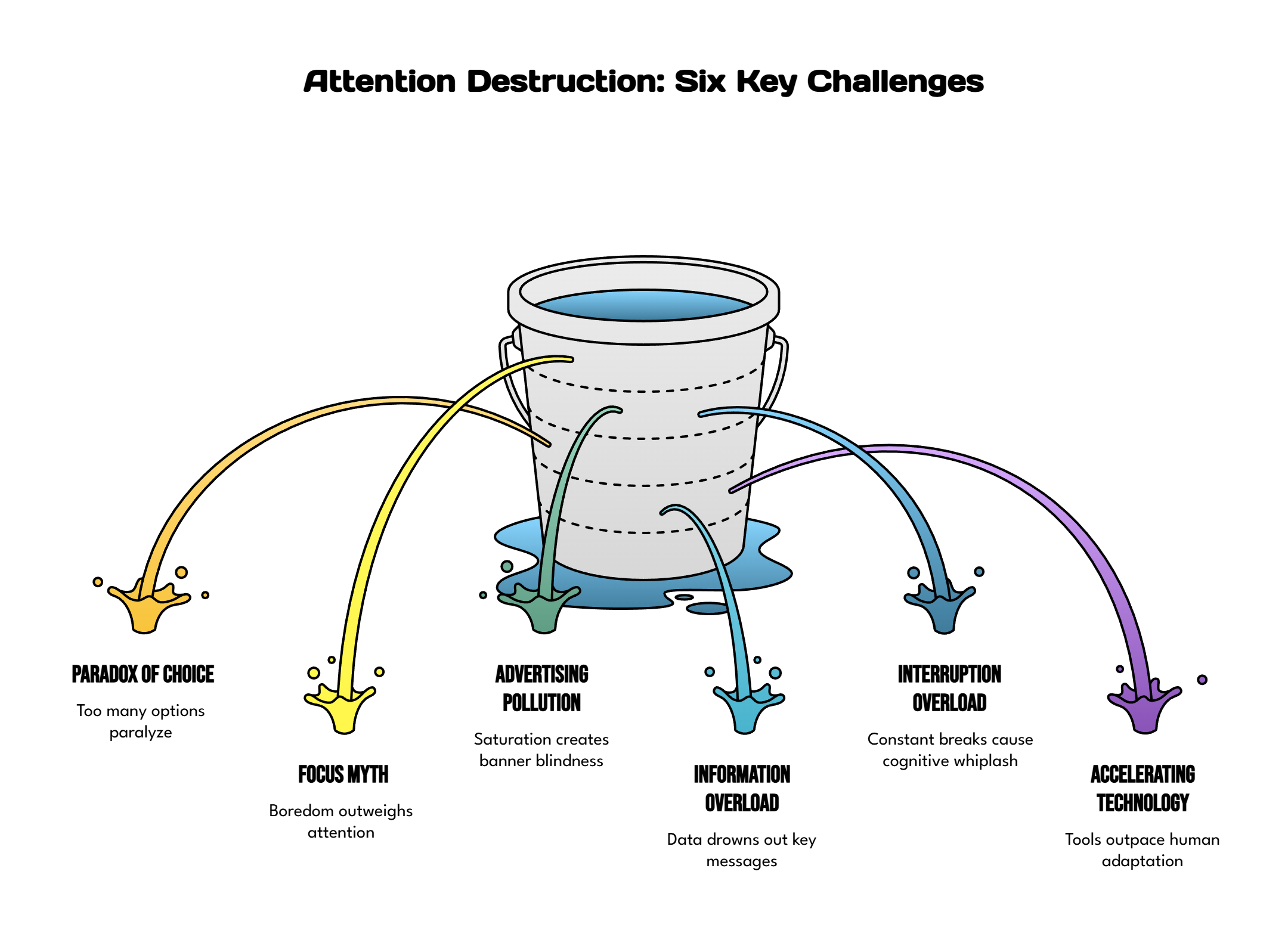
Marketing in the Age of Attention Deficit – The 6 Key Challenges
The tools change faster than you can master them. The platforms shift faster than you can adapt. And somewhere in that chaos, your customer is just trying to survive.
The Corpse of Interruption Marketing
Here’s a number that should keep traditional advertisers up at night: 82%.
That’s the percentage of TV ads that fail to generate a positive ROI.
Not break-even. Negative. You’d be better off lighting the money on fire. At least that would keep you warm.
The interruption model is dead. It died because it assumes a captive audience. But in 2025, the audience has succeeded. They have DVRs, ad-blockers and streaming subscriptions. They can skip, scroll, mute, and unsubscribe.
The broadcast contract is broken. And no amount of louder, flashier, more intrusive advertising will repair it.
The Person Nobody Wants to Hear From
Want to know who the #1 person nobody wants to hear from is?
A marketer.
The moment your prospect smells a sales message, their defences go up. Not consciously. Automatically. The persuasion knowledge model kicks in. They’ve been burned before. They know the game. And they’re not playing anymore.
Dell learned this the hard way. One frustrated customer. One blog post. “Dell Hell.” Two million Google results. Years of brand damage from a single voice they tried to ignore.
Rule #1 of the new reality: Your marketing cannot defeat a community.
They hold the power now. Not you. Not your budget. Not your media buy. The community builds brands. The community kills them.
The Maven Alternative
So if you can’t interrupt your way to attention, what’s left?
Earning it.
The infographic calls this “From Marketer to Maven.” I call it the only viable business model in an attention-scarce world.
A Maven is a trusted expert who generously shares knowledge. Not a seller. A teacher. Not a taker. A giver.
The old transaction: Give money, get product.
The new transaction: Give value, get attention.
You have to provide something of genuine benefit—education, entertainment, utility—before you’ve earned the right to ask for anything.
This isn’t soft. It’s strategic. In a world of cognitive exhaustion, trust is the only currency that still spends.
The Four Rules That Actually Matter
The connected world runs on different physics. Here are the laws:
Rule #1: Your marketing cannot defeat a community. They hold the power to build or kill your brand. Stop fighting. Start serving.
Rule #2: You can’t trick people. In a connected world, deception gets exposed. Everyone talks. Secrets travel at the speed of screenshot.
Rule #3: There’s nowhere to hide. The web is the world’s biggest lie detector. Greenwashing? Caught. Fake reviews? Exposed. Cheaters get found.
Rule #4: Your secrets aren’t safe. An army of amateur investigators lives for exposing hidden truths. Whistleblowers have megaphones now.
The common thread? Transparency isn’t optional anymore. The only sustainable strategy is being worthy of the attention you seek.
The Six Steps to Earning Your Way In
If you’re ready to stop polluting and start contributing, here’s the path:
Step 1: Map Your Market. Find the influential people and active communities in your niche. Don’t target “everyone.” Target the sneezers—the people who spread ideas. Influence travels through nodes, not broadcasts.
Step 2: Monitor Your Market. Listen before you speak. Understand the conversations happening in blogs, forums, and social media. Learn the language. Identify the pain points. Stop assuming you know what matters.
Step 3: Join Your Market. Enter the conversation with humility. Don’t barge in with a pitch. Ask questions. Add value. Play nice. Earn your right to participate.
Step 4: Build Your Market. Become more educated than anyone else in your space. Serve with authority. Build a reputation for reliability and expertise. This is where Mavenhood begins.
Step 5: Lead Your Market. Start your own conversation. Own the thought leadership space. Create the platform others reference. Become the source, not the echo.
Step 6: Sell Your Market. Only now—after you’ve mapped, monitored, joined, built, and led—do you create a product that serves the community. The sale is the result of the relationship, not the start of it.
Notice what’s missing? Interruption. Force. Volume.
The path is slower. But it’s the only one that leads somewhere.
The Uncomfortable Truth About Your Competition
You’re not competing against other businesses anymore.
You’re competing against the biological limits of human cognition. Against the 24-hour day. Against every app, notification, email, and crisis. You are competing for the same finite bandwidth.
And here’s the thing: The bandwidth isn’t expanding. The human brain hasn’t upgraded its processing hardware in 50,000 years. But the input has increased by orders of magnitude.
Something has to give. And that something is you—if you keep playing by the old rules.
The Only Asset That Matters
In the Attention Economy, the most valuable asset isn’t the content you produce.
It’s the trust you preserve.
Content is infinite. Anyone can make it. AI can make it by the terabyte. But trust? Trust is scarce. Trust takes years to build and seconds to destroy. Trust is the thing your customer is protecting when they install ad blockers, unsubscribe from newsletters and ignore your “quick follow-up.”
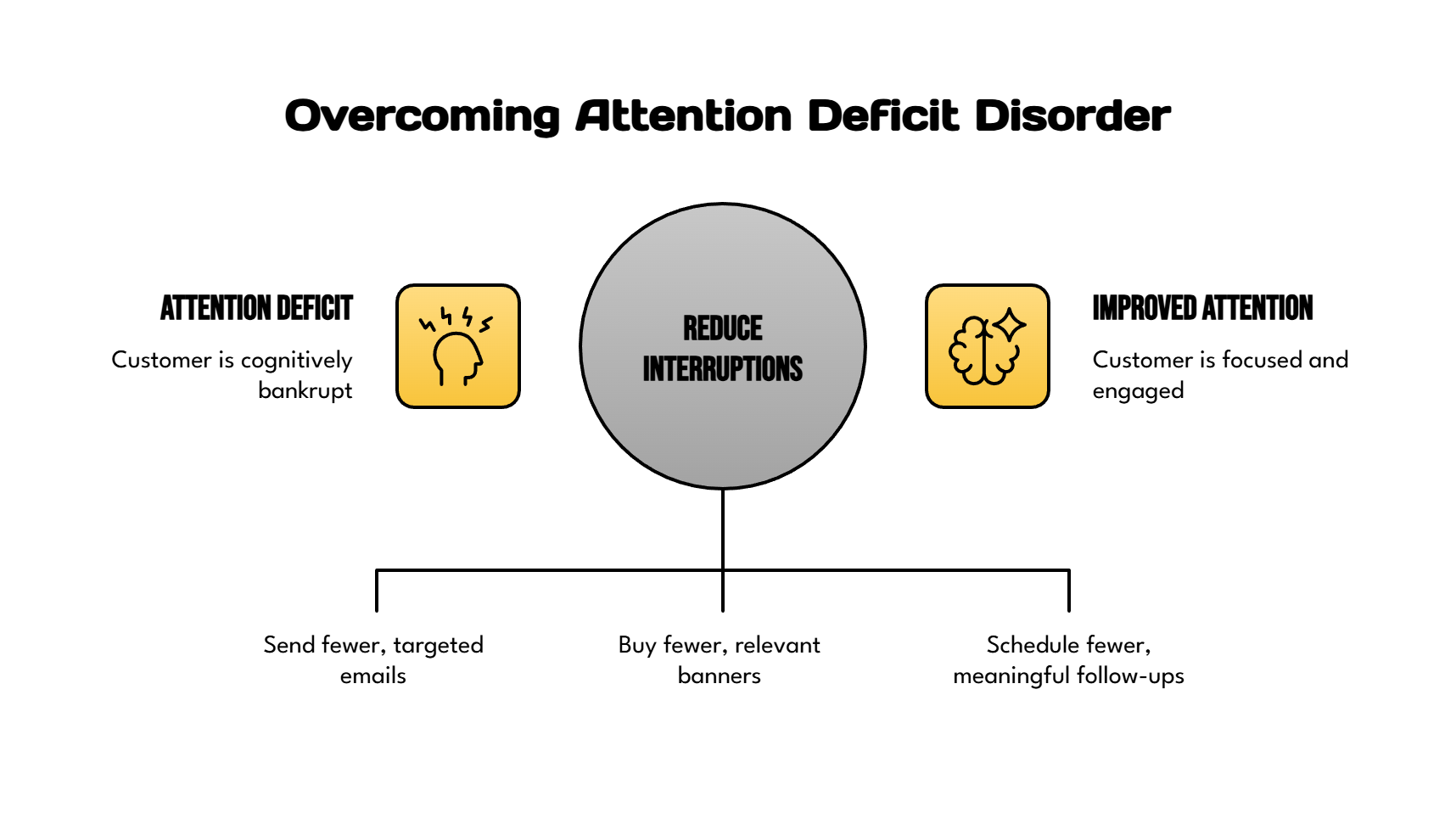
of Attention Deficit – How to Reduce Interruptions
They’re not rejecting your product. They’re protecting their cognitive space from exploitation.
The question isn’t whether you can get attention. It’s whether you deserve it.
The Path Forward
The Attention Deficit World isn’t a temporary anomaly. It’s the structural reality of our time. The collision between infinite information and finite human cognition creates an environment where traditional marketing doesn’t just fail—it actively makes things worse.
You have two choices:
- Keep polluting. Buy more ads. Send more emails. Interrupt harder. Watch your ROI crater while your reputation erodes.
- Become a Maven. Earn attention through value. Build trust through service. Lead through expertise. Accept that the only way to get permission is to deserve it.
The first path is easier in the short term and guaranteed to fail in the long term.
The second path is harder—but it’s the only one with a destination.
The Final Question
Here’s what it comes down to:
In a world drowning in noise, what makes you signal?
Not your budget. Not your reach. Not your clever copy.
Your utility. Your generosity. Your trustworthiness.
The attention economy has one iron law: You can’t take attention. You can only earn it.
So.
What are you doing today to be worth noticing tomorrow?
The future belongs to the Mavens. The organisations that stop trying to defeat the community with marketing muscle and start serving the community with cognitive empathy.
In the Attention Economy, the winners aren’t the loudest.
They’re the most useful.