The Compass in the Noise
A Manifesto for the Lost Generation of the Informed
“Information creates the illusion of understanding. Wisdom creates the reality of direction.”
Here is the uncomfortable truth nobody wants to hear:
You are not smarter because you have more data. You are more dangerous.
We have built the most informed civilisation in the history of the species, and we have absolutely no idea where we are going. We have answers to every conceivable question sitting in our pockets, vibrating against our thighs every six seconds, and yet — when the moment arrives that actually demands clarity, when the stakes are real and the path forks — we freeze. We scroll. We “research.” We mistake the dopamine hit of another data point for the hard, terrifying work of making a decision.
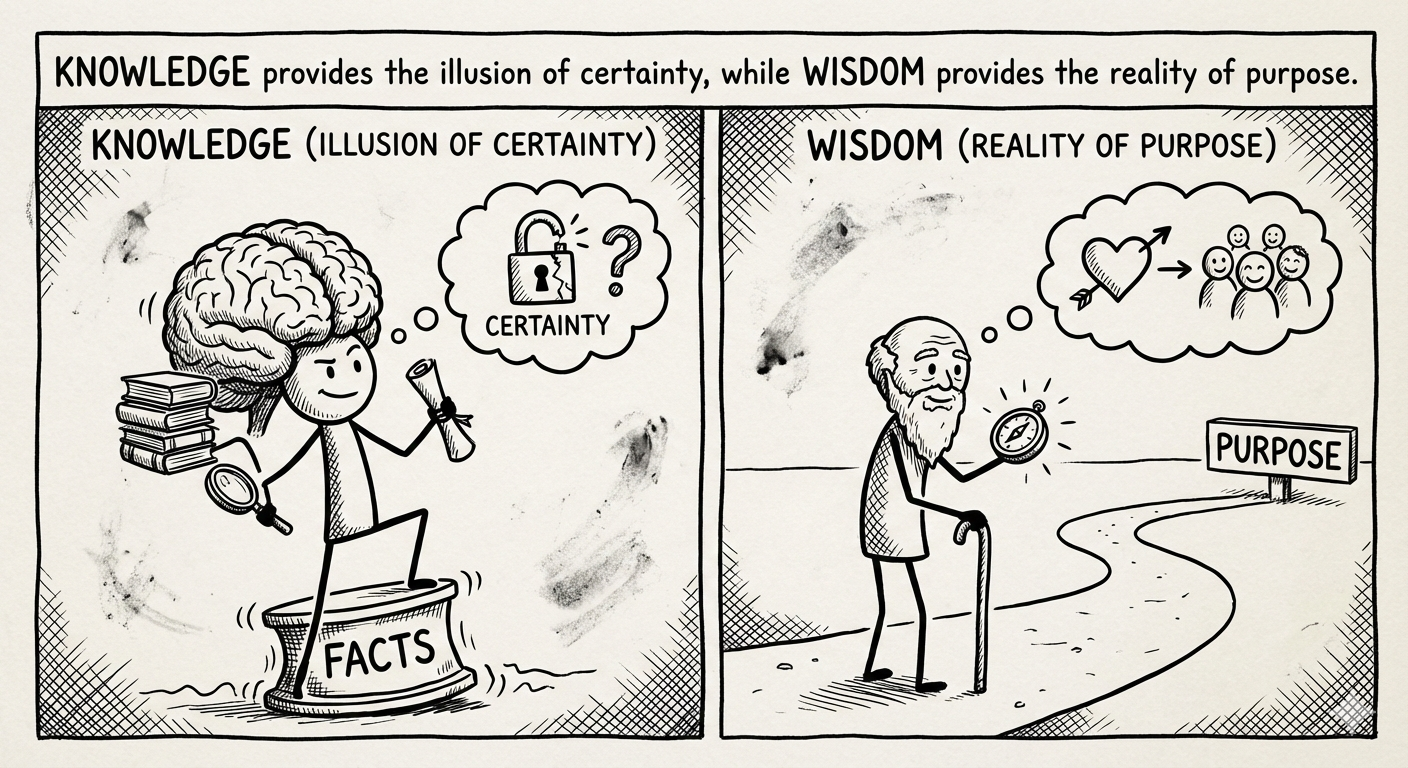
Wisdom provides the reality of purpose
This is not a knowledge problem. This is a courage problem.
And it is killing us.
The Information Trap
We are living through an era of unprecedented intellectual gluttony.
Not intellectual growth. Gluttony.
There is a difference. Growth requires digestion. Gluttony is just consumption for its own sake — the all-you-can-eat buffet of opinions, statistics, breaking news, and hot takes that we gorge on daily and mistake for nourishment.
Consider what we have built: a world where every answer is a search query away. Every historical fact, every medical symptom, every legal precedent, every market trend — indexed, categorised, and served to you in 0.47 seconds. We have more information at our fingertips than every library in ancient Alexandria combined, multiplied by a factor that would make a mathematician weep.
And we are profoundly lost.
Because having the encyclopedia does not make you enlightened. It makes you indexed.
Information is cheap. It has never been cheaper. The marginal cost of one more fact is essentially zero. And like everything that becomes free and unlimited, it has been catastrophically devalued. We treat data the way fast fashion treats fabric — consume it, discard it, consume more, and never once ask whether any of it is making us better dressed.
Here is what information actually gives you: the exact coordinates of your current location, the historical record of how you arrived, and a statistical probability model for what might happen next. That is it. That is the ceiling.
And we have confused this ceiling with the sky.
“The greatest enemy of knowledge is not ignorance, it is the illusion of knowledge.” — Daniel J. Boorstin
The illusion is not that we lack data. The illusion is that data, by itself, constitutes understanding. It does not. It never has. And the people who mistake the map for the territory are the ones most confidently walking off the cliff.
The Map and the Compass
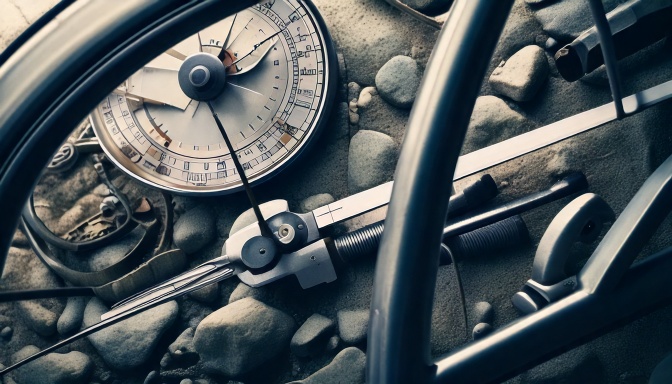
If information is the sprawling, overwhelmingly detailed map of human existence — every road, every contour line, every elevation marker rendered in excruciating detail — then wisdom is the compass.
A map without a compass is a decoration. Expensive, perhaps. Impressive, certainly. But fundamentally useless for the one thing that actually matters: knowing which direction to walk.
You can memorise every topological feature on that map. You can trace every river, name every mountain range, and recite the longitude and latitude of every capital city on earth. But without an internal True North — without the hard-won, battle-scarred, failure-forged instinct that tells you this way and not that way — you will wander in beautifully informed circles until you die.
This is the critical distinction that our age refuses to make:
Information is acquired. Wisdom is forged.
You acquire information by opening a browser. You forge wisdom by opening a wound. Wisdom requires the friction of lived experience, the humility that only failure can teach, the emotional scar tissue that transforms a clever person into a wise one. It demands that you sit with ambiguity long enough to hear what it is telling you, rather than Googling your way to a premature conclusion.
Information tells you what is possible. Wisdom tells you what matters.
Information gives you options. Wisdom eliminates them.
Information says, “Here are a million paths.” Wisdom says, “We go this way.”
“The only true wisdom is in knowing you know nothing.” — Socrates
Socrates said this 2,400 years ago, when the sum total of human knowledge could fit in a single library. Imagine what he would say now, watching us drown in a sea of data while claiming to understand the ocean.
The Dangerous Space Between Motion and Progress
This is where it gets lethal.
When we rely solely on information — when we let the map replace the compass — we make a catastrophic error. We mistake motion for progress.
We build faster algorithms. We optimise supply chains. We construct more complex systems, more elaborate dashboards, more granular analytics. We celebrate speed and scale as inherently virtuous, as though the sheer velocity of our activity is evidence that we are headed somewhere worth arriving.
But progress without purpose is just acceleration toward a cliff.
“There is nothing so useless as doing efficiently that which should not be done at all.” — Peter Drucker
Read that again. Let it settle. Because this is not a theoretical problem. This is the defining pathology of our era. We have become world-class at optimising systems that should never have been built. We are sprinting — with impeccable form, extraordinary technology, and real-time performance metrics — in the wrong direction.
- Information builds the atomic bomb. Wisdom decides whether to use it.
- Information optimises the supply chain. Wisdom asks what we are supplying and to whom.
- Information creates the echo chamber. Wisdom seeks out the dissenting voice.
- Information scales the startup. Wisdom asks whether it should exist at all.
- Information measures engagement. Wisdom questions what we are engaging with.
Every single one of these is a real failure mode that exists right now, today, in organisations that have more data than they know what to do with and less direction than they are willing to admit.
The data-rich and direction-poor organisation is the most common corporate pathology of our time. And it is not a technology problem. It is a leadership problem.
The Bridge That No One Wants to Cross
So what is the bridge between raw data and actual wisdom? What transforms a fact into a lesson, a statistic into a conviction, a piece of information into a decision you would stake your reputation on?
Three things. And you are not going to like any of them.
1. Time
Wisdom cannot be microwaved. There is no hack, no shortcut, no “5 Steps to Wisdom” blog post that will substitute for the slow, grinding, unglamorous process of living through something and coming out different on the other side. The cult of speed has taught us that faster is always better. It is not. Some things only ripen with time, and wisdom is one of them.
The instant you try to accelerate wisdom, you get something else entirely. You get cleverness. And cleverness, mistaken for wisdom, is how empires fall.
2. Failure
Not the sanitised, TED-Talk version of failure where you “learned so much” and “would not change a thing.” Real failure. The kind that costs you money, relationships, sleep, and certainty. The kind that sits on your chest at 3 a.m. and forces you to reckon with the difference between what you thought you knew and what turned out to be true.
“Good judgment comes from experience, and experience comes from bad judgment.” — Rita Mae Brown
Wisdom is not the avoidance of mistakes. It is the distillation of mistakes into something that will not let you make them again the same way. Information can warn you about the pothole. Only wisdom — the kind you earn by falling into it — will change the way you walk.
3. The Courage to Synthesise
This is the one nobody talks about. Because synthesis is not just an intellectual exercise. It is an act of courage.
Synthesis means looking at contradictory data, incomplete information, and irreducible uncertainty — and making a call anyway. It means accepting that you will never have enough data to be certain, and choosing a direction regardless. It means putting your name on a decision before the results are in.
Information is the comfort of knowing. Wisdom is the courage of choosing.
And in a world that worships certainty — that demands evidence before action and proof before belief — choosing without complete information feels reckless. It is not. It is the most important thing a human being can do.
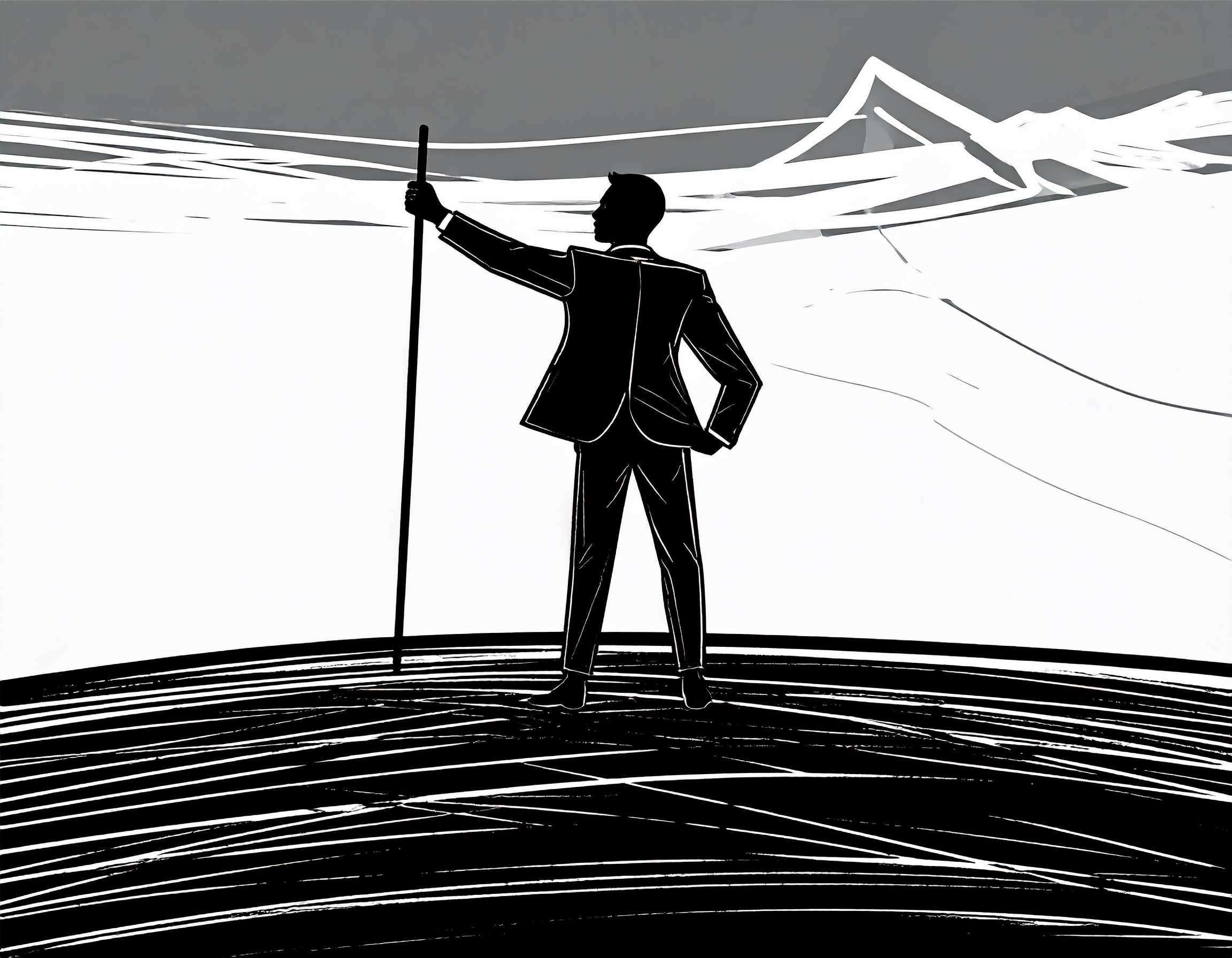
Courage to Stand for Purpose
The Reality of Direction
Here is what wisdom actually does that information cannot:
Wisdom tells you which problem is worth solving.
Not which problem is most visible, most trending, most algorithmically promoted, or most likely to generate clicks. Which problem matters? Which problem, if solved, changes the trajectory of a life, a business, a community, a generation?
Information gives you a list of a thousand problems. Wisdom draws a circle around one and says, “This. This is the one.”
Wisdom tells you when to pivot.
Not when the data says to pivot. The data is always late. By the time the numbers confirm what your gut already knows, you have wasted months — sometimes years — optimising a direction that stopped making sense long ago. Wisdom pivots before the spreadsheet gives permission.
Wisdom tells you how to proceed with integrity.
Information is amoral. It does not care whether you use it for good or ill. It will cheerfully optimise a predatory lending algorithm or a childhood literacy program with exactly the same mathematical indifference. Wisdom brings the moral dimension that information lacks. It asks not just “Can we?” but “Should we?” Not just “What works?” but “What is right?”
“In a time of drastic change, it is the learners who inherit the future. The learned usually find themselves equipped to live in a world that no longer exists.” — Eric Hoffer
The learned — the information-saturated — are perfectly equipped for yesterday. The learners — the wisdom-seekers — are building tomorrow.
The Manifesto
So here is where we draw the line.
We do not need more information. We are drowning in it. Another dashboard will not save us. Another analytics platform will not illuminate the path. Another quarterly report, another industry benchmark, another competitive analysis — none of it will substitute for the one thing that actually moves the needle:
The courage to pick up the compass.
This is a call to every leader, creator, builder, and thinker who has ever felt the paralysis of too much data and too little conviction:
Put down the map.
Stop pretending that one more data point will make the decision for you. It will not. Decisions are made by people with the courage to be wrong, the integrity to choose anyway, and the wisdom to know the difference between motion and progress.
Stand for purpose.
Not a purpose as a brand exercise. Not a purpose as a slide in the investor deck. Purpose as the non-negotiable foundation upon which every decision, every strategy, every line of code, and every hire is built. Progress without purpose is just expensive chaos. Purpose without progress is just philosophy. They are inseparable, and treating them otherwise is the root of every organisational failure you have ever witnessed.
Seek the dissenting voice.
The echo chamber is the natural habitat of the informed-but-unwise. It feels safe. It feels validating. It is a death trap. Wisdom lives in the uncomfortable conversation, the contradictory data, the perspective you would rather not hear. Seek it out. Every single time.
Make the call.
With incomplete information. With imperfect knowledge. With the full awareness that you might be wrong. Make it anyway. Because the cost of inaction — the slow, invisible decay of waiting for certainty that will never arrive — is always higher than the cost of a well-reasoned wrong turn.
“The opposite of a correct statement is a false statement. But the opposite of a profound truth may well be another profound truth.” — Niels Bohr
The world does not need more correct statements. It needs more profound truths. And profound truths do not come from data. They come from people who have the courage to look at the data, look at the void, and say: “I know enough. Let us go.”
The Fork in The Road
Information will tell you the odds.
Wisdom will tell you the odds do not matter.
The compass does not care about the terrain. It does not adjust its reading based on the difficulty of the path. It does not soften its direction because the way forward is uphill. It simply points. Unapologetically. Unwaveringly. True North.
That is what wisdom does. It points. Not where the data says to go. Not where the crowd is heading. Not where the path of least resistance leads. It points toward what matters, and it never stops pointing, even when — especially when — nobody else can see the destination yet.
The question is not whether you have enough information.
You do. You have always had enough.
The question is whether you have the courage to stop gathering and start going.
The compass is in your hand.
Pick it up.
“We do not need more information. We are drowning in it. What we desperately need are leaders, creators, and thinkers who are willing to put down the map, pick up the compass, and lead us forward.”