

A Conversation About Why Your Business Systems Keep Failing (And What to Do About It)
Let me tell you something that might sting a little.
You’ve been lied to about business systems. Not by bad people with malicious intent, but by well-meaning consultants, software vendors, and business gurus who genuinely believe they’re helping you. They’ve told you that systematising your business is about documenting processes, implementing software, and training your team. They’ve sold you the dream that if you just follow their methodology, buy their platform, or adopt their framework, everything will fall into place.
And you believed them because it made sense. Because it sounded logical. Because you desperately wanted it to be true.
So you did the work. You spent weeks mapping out your processes. You created the standard operating procedures. You bought the CRM, the project management tool, and the automation platform. You trained your team. You felt optimistic. This time, you thought, this time it’s going to stick.
But it didn’t, did it?
Three months later, maybe six if you were lucky, you looked around and realised that nobody was actually following the processes. The CRM was half-empty. The automation workflows were broken because you can’t automate chaos. Your team had quietly reverted to doing things “their way.” If there is no reinforcement in the form of positive encouragement, the change doesn’t last. And you were back to firefighting, back to chaos, back to being the only person who could hold it all together.
Your competitors aren’t worried about you systematising your business. They’re counting on you staying exactly as you are—talented, hardworking, and structurally trapped. Every week you delay is a week they gain ground you’ll never recover. The irony? You’re working harder than them while they’re building something worth more.
I know this story because I’ve heard it a hundred times. I’ve lived it myself. And I’ve spent years trying to understand why this keeps happening to smart, capable entrepreneurs who genuinely want to build better businesses.
Here’s what I’ve learned: The problem isn’t your processes. The problem is that you’re trying to fix a three-dimensional problem with a one-dimensional solution.
Let me explain what I mean.
The Three-Legged Stool You’ve Been Ignoring
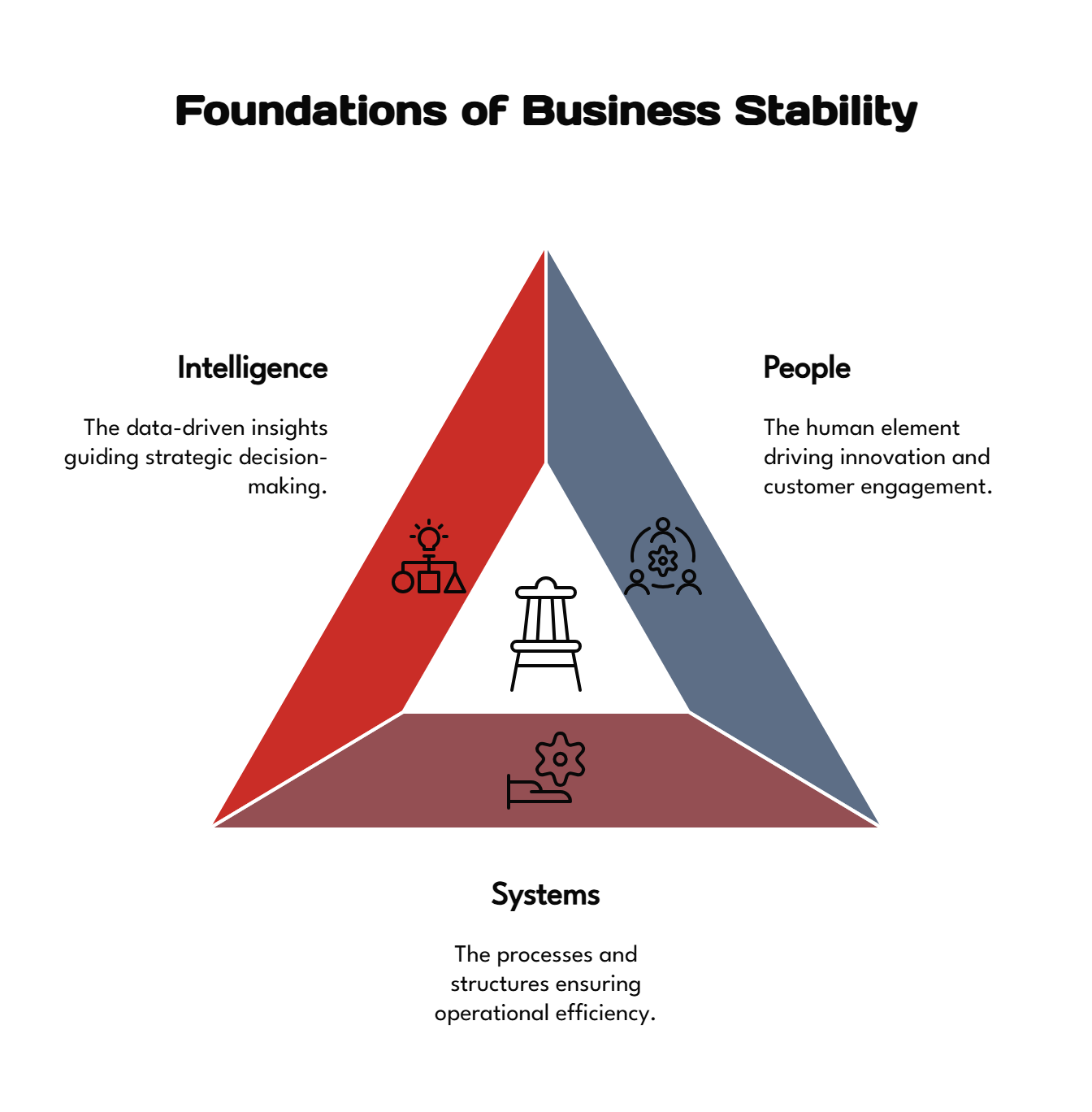
Imagine a three-legged stool. Simple enough, right? Now imagine that each leg represents a critical pillar of your business. One leg is your systems and processes—the operational workflows, the documented procedures, the technology infrastructure. Another leg is your human capital—your people, your culture, your leadership, your team’s engagement and capabilities. The third leg is your financial intelligence—your ability to make data-driven decisions, allocate capital wisely, and measure what actually matters.
Now here’s the question that changes everything:
What happens if one leg is shorter than the others?
Or worse, what happens if you’ve been obsessively building one leg while completely ignoring the other two?
The stool tips over. You fall. The business collapses.
This is the insight that most entrepreneurs miss, and it’s why your systematisation efforts keep failing. You’ve been building beautiful, sophisticated systems—documenting processes, implementing technology, creating workflows—while your people aren’t engaged enough to follow them and your financial intelligence isn’t developed enough to measure whether they’re actually working.
It’s like building a Ferrari engine and dropping it into a car with no transmission and square wheels. The engine is magnificent, but the car isn’t going anywhere.
This three-legged stool is what I call the Triangular Advantage. It’s not my invention—it’s a framework that emerges when you study the world’s most successful organisations and ask why they succeed while others fail. Companies like Toyota, Amazon, Microsoft, and Tesla don’t just have great systems. They have great systems that are perfectly synchronised with exceptional human capital and razor-sharp financial intelligence.
And that synchronisation—that’s the secret sauce that nobody talks about.
Why Synchronisation Matters More Than Excellence
Here’s a truth that will make some people uncomfortable: Isolated excellence is a recipe for mediocrity.
You can have the most sophisticated ERP system in your industry, but if your people aren’t trained to use it, aren’t incentivised to use it, and don’t work in a culture that values process compliance, that system is worthless. In fact, it’s worse than worthless—it’s expensive worthless. You’ve invested time and money into something that’s actively creating frustration and resentment.
Or consider this scenario: You’ve built an incredible team of champions. They’re talented, engaged, capable and highly passionate about the work and contribution they make. But you haven’t documented any processes; you’ve left it to them to sort out at their discretion: different person, variable outcome. Every person does things their own way. Improvisation wins over systems. The core knowledge resides in the heads of core people rather than in a central document management system. There’s no consistency, no predictability, and no ability to scale. When someone leaves, their knowledge walks out the door with them. Your human capital is excellent, but without systems to channel that excellence, you’re just running a costly hobby.
Or maybe you’re the analytical type. You’ve built dashboards, you track metrics, you make data-driven decisions. But your systems are chaotic, and your people are disengaged, so the data you’re analysing is garbage. You’re making precise decisions based on imprecise information. Your financial intelligence is sharp, but it’s cutting through fog.
This is what I mean by isolated excellence creating mediocrity. Each pillar, developed in isolation, creates the illusion of progress while actually trapping you in a cycle of frustration.
But when you synchronise all three pillars—when your systems generate accurate data that informs your financial decisions, which justify investments in your people, who then leverage your systems to innovate and execute with excellence—something magical happens. It’s not additive. It’s not linear. It’s exponential.
Culture Building – Triangle Advantage OS
The research backs this up. Organisations that excel at enabling human performance are almost two times more likely to report better financial results. Companies with engaged workforces outperform their peers with 23% higher profitability. Businesses that implement systematic process improvement achieve 15-25% efficiency gains within the first year, with ROI ranging from 200-400% within 18-24 months. (Deloitte, Human Capital Trends, 2025).
These aren’t minor differences. These are the differences between businesses that struggle to find the way around and businesses that structurally dominate. Between entrepreneurs who are trapped in their businesses and entrepreneurs who have built assets that work without them.
The Three Types of Misalignment (And How to Recognise Them in Your Business)
Let me get practical for a moment. If you’re reading this and thinking, “Okay, I get it, synchronisation matters—but how do I know if I’m misaligned?” here’s how to diagnose it.
The first type of misalignment happens between your systems and your people. You build processes, but nobody follows them. You implement technology, but adoption is terrible. You create workflows, but your team finds workarounds. This is the most common form of misalignment, and it’s usually a culture problem disguised as a systems problem.
Here’s what’s really happening: Your people don’t believe in the systems. Maybe they weren’t involved in designing them. Perhaps they don’t understand why they matter. Maybe they’ve seen too many “flavour of the month” initiatives that got abandoned after a few weeks. Perhaps they’re not incentivised to follow them. Maybe your leadership team doesn’t model process compliance. Whatever the reason, you’ve created systems that exist on paper but not in reality.
The fix isn’t better systems. The fix is better change management, better communication, better incentives, and better leadership. You need to build a culture where following systems is non-negotiable, where process compliance is tied to compensation and promotion, and where leaders model the behaviour they expect. You need to involve your team in designing the systems so they have ownership. You need to celebrate wins and recognise improvements. You need to make the following systems the path to success, not an annoying obligation.
The second type of misalignment happens between your systems and your financial intelligence. You have processes, maybe even good ones, but you’re not measuring their impact. You don’t know if they’re actually making you money. You can’t connect operational metrics to financial outcomes. You’re flying blind, making decisions based on gut feel rather than data.
This is insidious because it feels like you’re doing the right things. You’re documenting processes, you’re implementing systems, you’re being “professional.” But without the feedback loop of financial intelligence, you don’t know if you’re optimising the right things. You might be making your worst processes more efficient while ignoring your most significant constraints. You might be investing in systems that don’t move the needle while starving the areas that would actually drive growth.
The fix is integration. Your systems need to generate data. That data needs to flow into dashboards that connect operational metrics to financial outcomes.
You need to define your Critical Success Factors—the three to five metrics that actually determine whether you succeed or fail—and review them weekly. You need to make every decision based on data, not intuition. You need to calculate the ROI of every system investment and ruthlessly divest from things that don’t pay off.
The third type of misalignment happens between your financial intelligence and your people. This is when your finance function is disconnected from the human element of the business. Finance sees people as expenses to be minimised rather than assets to be developed. Training budgets get cut. Hiring gets frozen. Talent development gets deprioritised. And slowly, insidiously, your competitive advantage erodes because you’re starving the very thing that drives innovation and growth.
This happens because most entrepreneurs and CFOs are trained to think about financial management in terms of cost control. And in the short term, cutting people costs improves your bottom line. But in the medium and long term, it destroys your ability to compete. Your best people leave. Your remaining people become disengaged. Your innovation slows. Your customer experience suffers. And eventually, you lose market share to competitors who invested in their people while you were cutting costs.
I am confident to say that management practices when you see people as a cost centre first, will (most likely) crush your triangle and create numerous frictions in your business model.
The fix is a mindset shift. You need to start thinking about talent investment as capital expenditure, not operating expense. You need to calculate the ROI of training, hiring, and culture-building the same way you calculate the ROI of equipment or technology. You need to recognise that top-performing companies invest 50% more in capital expenditures than their peers, and that includes human capital. You need to make the business case for people investment, not just accept that “there’s no budget.”
What Happens When You Get the Triangle Right
I want to paint a picture for you of what business looks like when all three pillars are synchronised, because I think most entrepreneurs have never experienced it. They’ve spent so long in chaos that they don’t even know what excellence feels like.
Imagine waking up on Monday morning and not immediately feeling dread about what fires you’ll need to put out. Imagine starting your laptop and opening the inbox and seeing updates from your team about projects moving forward, problems being solved, customers being delighted—all without your intervention. Imagine looking at your dashboard and seeing precise, accurate data that tells you exactly where you are, where you’re going, and what needs to change.
Imagine having a team that actually follows your processes because they understand why they matter and they’re incentivised to use them. Imagine having systems that generate reliable, consistent results regardless of who’s executing them. Imagine having the financial intelligence to know exactly which investments will drive growth and which ones are wasting money.
Imagine being able to take a two-week vacation without everything falling apart. That would be something! Imagine being able to say no to opportunities that don’t align with your values and strategy because you have precise data showing what actually drives value. Imagine having a business that runs without you (or with your minimal involvement, mening on the operational level), that grows without you being the bottleneck, that has real value to a potential buyer because it’s not dependent on your personal involvement.
This isn’t fantasy. This is what happens when you synchronise the Triangle.
Triangular Advantage OS
I’ve seen it happen. I’ve worked with businesses that made this transformation. They started with chaos—overwhelmed entrepreneurs, disengaged teams, inconsistent results, unclear finances. They ended with systems that work, teams that execute, and data that guides smart decisions. The transformation typically takes about 90 days of focused work. Not easy work—uncomfortable, challenging, ego-bruising work. But 90 days of that work creates a foundation that changes everything that comes after.
The businesses that fail aren’t the ones that tried and struggled. They’re the ones where the owner knew exactly what needed to happen and chose comfort over commitment. Ten years from now, you won’t remember the 90 days of uncomfortable work. But you’ll absolutely remember another decade of chaos.
The typical results look something like this: Within 30 days, you have your first process documented and working, your team is starting to follow it, and you’re tracking your Critical Success Factors weekly. Within 60 days, you have three processes documented, your constraint is identified and being addressed, and you’re making data-driven decisions habitually. Within 90 days, you have four or more processes documented and optimised, a complete measurement system in place, a culture of continuous improvement taking root, and measurable efficiency gains of 10-15%.
But here’s what matters more than the numbers: You feel different. The constant anxiety starts to fade. The sense of being trapped starts to lift. You begin to see a path forward. You start to believe that building a real business—not just a job you own—is actually possible.
And over the next year, that foundation compounds. You document 15-20 processes. You systematise all your core operations. You build a business that can run for two weeks without you. You achieve efficiency gains of 25-40%. You increase the value of your business by 2-3x because it’s no longer dependent on you personally.
This is what synchronisation creates. Not perfection—there’s no such thing. But progress. Real, measurable, sustainable progress.
The Uncomfortable Truth About Why You Haven’t Done This Yet
Let me be direct with you about something. If you’re reading this and thinking, “This makes sense, I should do this,” but you’re not immediately blocking out time on your calendar to start, there’s a reason for that.
It’s not because you don’t have time. You have the same 24 hours as everyone else, and somehow, other entrepreneurs are building systematised businesses while you’re stuck in firefighting mode. It’s not because you don’t have the knowledge. You’ve read the books, taken the courses, and hired the consultants. You know what needs to be done.
The reason you haven’t done this yet is that it’s uncomfortable.
Systematising your business forces you to confront some brutal truths. It forces you to admit that the chaos in your business is your fault. Not your team’s fault. Not your market’s fault. Not your circumstances’ fault. Yours. You created this situation by not building systems earlier. You perpetuate this situation by continuing to firefight instead of building the foundation that would prevent it.
It forces you to admit that you might not be as indispensable as you think you are. That’s the reason you’re involved in everything, isn’t it, because you’re the only one who can do it—it’s because you haven’t documented how to do it and trained someone else. Your ego is wrapped up in being needed, being the hero, being the person who saves the day. Systematisation threatens that identity.
It forces you to do work that feels unproductive. Documenting processes doesn’t feel like “real work.” It doesn’t generate immediate revenue. It doesn’t close deals. It doesn’t solve today’s crisis. It’s investment work, not production work. And most entrepreneurs are addicted to production work because it gives them the dopamine hit of visible progress.
It forces you to hold your team accountable in ways you’ve been avoiding.
If you document processes and people don’t follow them, you have to have difficult conversations. You have to enforce consequences. You have to be willing to say,
“This is how we do things here, and if you can’t do it this way, you can’t work here.”
That’s uncomfortable. It’s easier to just accept that everyone does things their own way and keep firefighting.
And perhaps most uncomfortably, it forces you to commit to finishing something. You’ve started systematisation projects before. You’ve documented some processes. You’ve implemented some tools. And then you got busy, or distracted, or discouraged, and you let it slide. This time, if you’re going to do it right, you have to commit to finishing. You have to commit to 90 days of focused work even when it’s hard, even when it’s boring, even when you’d rather be doing something else.
This is why most entrepreneurs never systematise their businesses. Not because they don’t know how. Because they’re not willing to be uncomfortable.
But here’s the thing:
The discomfort of systematisation is temporary. The discomfort of chaos is permanent. You get to choose which discomfort you want to live with.
The 90-Day Journey From Chaos to Clarity
Let me walk you through what the actual transformation looks like, because I think the abstract concept of “synchronising the Triangle” can feel overwhelming. What does that actually mean in practice? What do you do on Monday morning?
The first month is about brutal honesty and foundation-building. You start by calculating what chaos is actually costing you. Not in some vague, hand-wavy way, but in actual dollars. You calculate the time cost—how many hours per week you spend firefighting, multiplied by your hourly rate. You calculate the money cost—lost deals, refunds, inefficiencies, mistakes. You calculate the opportunity cost—revenue you can’t generate because you’re drowning in operations. For most businesses, this number is somewhere between $100,000 and $500,000 per year. That’s what you’re paying to not have systems.
Then you map your current state. You identify the six core systems every business needs: lead generation, sales, fulfilment, finance, operations, and people. You rate each one on a scale of one to ten. Most entrepreneurs discover they have maybe two systems that are actually systematised, and the rest are held together with duct tape and heroic effort.
Then you find your constraint. This is critical. You can’t systematise everything at once—that’s a recipe for overwhelm and failure. You need to identify the single biggest bottleneck in your business, the place where work piles up, where delays happen most often, where everything depends on one person. That’s where you start.
By the end of the first month, you’ve documented your first process. Not perfectly—perfection is the enemy of progress. But documented well enough that someone else can follow it. You’ve tested it with your team. You’ve trained them on it. You’ve tied compliance to their incentives. And you’ve started tracking your Critical Success Factors—the three to five metrics that actually determine whether you succeed or fail.
The second month is about building momentum and measurement. You document your second and third processes. You start to see how processes connect to each other, how handoffs work, how information flows. You establish a weekly rhythm of reviewing your Critical Success Factors with your team. You start making decisions based on data instead of gut feel. You attack your constraint with a removal plan—reallocating resources, providing training, and eliminating waste.
This is where it gets hard. This is where the novelty wears off and the work feels tedious. This is where you’re tempted to quit, to go back to firefighting because at least that feels productive. But if you continue to push through, something starts to shift. Your team is starting to trust you more and finally recognises that this time is different. They start to follow the processes. It changes their beliefs and elevates commitment. They start to suggest improvements. The culture begins to change. And when you have them on your side, you almost predictably win.
By the end of the second month, you will have three processes documented and working. You have a weekly rhythm of data-driven decision-making. Your constraint is reduced or removed. You can measure the efficiency gains, typically 10-15% by this point. And you can feel the difference. The constant anxiety is starting to fade.
The third month is about optimisation and sustainability. You document your fourth process and beyond. You build a complete measurement system that connects operational metrics to financial outcomes. You train your team on continuous improvement. You empower them to suggest optimisations. You celebrate wins. You recognise improvements. You build the cultural muscle of systematisation so it becomes how you operate, not just a project you’re working on.
By the end of 90 days, you have documented and optimised four or more processes. You have a complete measurement system generating real-time data. You have a culture of continuous improvement taking root. You have measurable efficiency gains of 15-25%. And most importantly, you have a foundation. You’ve proven to yourself and your team that this works. You’ve built the momentum to keep going.
And that’s when the fundamental transformation begins. Because now you’re not starting from zero. You’re not fighting inertia. You’re building on a foundation. Over the next nine months, you document another 10-15 processes. You systematise all your core operations. You build a business that can run without you for two weeks, then a month, then indefinitely. You increase your efficiency by 25-40%. You increase your business’s value by 2-3x.
This is the journey. It’s not easy. But it’s simple. And it works.
What You Actually Need to Do (Starting Tomorrow)
I want to end this conversation with something practical, because insight without action is just entertainment. If you’ve read this far, you understand the Triangular Advantage. You understand why your systems have failed. You know what needs to change. Now the question is: What are you going to do about it?
“You don’t need a consultant who delivers solutions you can’t replicate. You need an architect who installs capability you own permanently. We don’t stack odds—we eliminate the structural deficits that created unfavourable odds in the first place. The deliverable isn’t project completion. It’s architectural transformation that performs long after we’re gone.”
Here’s what I want you to do. Not someday. Not when things calm down. Tomorrow.
First, calculate your cost of chaos. Block out 30 minutes on your calendar. Sit down with a spreadsheet. Calculate how many hours per week you spend firefighting—not doing strategic work, not building the business, but putting out fires and solving problems that shouldn’t exist. Multiply that by your hourly rate. Then add up the money costs—lost deals, refunds, inefficiencies, mistakes. Then estimate the opportunity cost—what revenue could you generate if you weren’t drowning in operations? Add it all up. Write that number down. That’s what you’re paying every year not to have synchronised systems.
Second, assess your Triangle. Rate each pillar on a scale of one to ten. Your systems and processes—how documented, consistent, and reliable are they? Your human capital—how engaged, skilled, and aligned is your team? Your financial intelligence—how data-driven are your decisions, how clear are your metrics, how sharp is your capital allocation? Which pillar is weakest? That’s where misalignment is killing you.
Third, identify your constraint.
Answer these five questions:
-
- Where does work pile up most often, and what is the cause?
-
- Where do delays happen most frequently (check upstream, capacity, capability)?
-
- What depends on you or one specific person (remember the danger of “1” in business)?
-
- What breaks most often?
-
- What would have the most significant impact if it were improved (what is that one thing that if improved, resolved, or eliminated, makes all the difference? One thing that changes everything)?
Your constraint is where these answers converge. That’s where you start.
Fourth, commit to 90 days. Write this down and sign it:
“I commit to implementing the Triangular Advantage OS for the next 90 days. I will document four to six processes. I will track my Critical Success Factors as a cornerstone of my commitments weekly. I will engage my team and explain it one more time till we get it right. I will make them see it for themselves. I will make data-driven decisions based on numbers and trends. I will not quit when it gets uncomfortable; instead, I will push harder. I will finish what I start.”
Then, put today’s date on it. Put it somewhere you’ll see it every day.
Fifth, start this week. Don’t wait for the perfect time. Don’t wait until things calm down. Don’t wait until you have more resources. Start now. Document your first process this week. It doesn’t have to be perfect. It just has to be done. Test it with your team. Train them on it. Start tracking your Critical Success Factors. Make your first data-driven decision.
That’s it. That’s what you need to do. Not complicated. Not easy. But simple.
The Choice You’re Actually Making
I want to be clear about something. This isn’t really a conversation about business systems. It’s a conversation about the kind of business you want to build and the kind of life you want to live.
You can keep doing what you’ve been doing. You can keep firefighting. You can keep being the hero who saves the day. You can keep telling yourself that things will calm down soon, that you’ll systematise once you have more time, that you’ll build the foundation once you’re past this busy season. And you can keep paying $100,000 to $500,000 per year in chaos costs while slowly burning out and wondering why your business never seems to get easier.
Or you can do something different. You can face the uncomfortable truth that the chaos is your fault and your responsibility to fix. You can commit to 90 days of focused, uncomfortable work. You can build the foundation that will change everything that comes after. You can create a business that runs without you, that grows without you being the bottleneck, that has real value because it’s not dependent on your personal involvement.
The difference between these two paths is not knowledge. You know what needs to be done. The difference is not resources. You have everything you need. The difference is commitment. The willingness to be uncomfortable. The discipline to finish what you start.
I’ve spent the last several months building something for entrepreneurs who are ready to make that commitment. A complete training program that walks you through every step of the 90-day transformation.
It’s everything you need to transform your business in 90 days.
Not theory. Not motivation. Not consultant speak.
Just a clear, evidence-based roadmap for synchronising your Triangle and building a business that actually works.
But here’s the thing: The materials don’t matter if you’re not ready to do the work. The best roadmap in the world is useless if you’re not willing to take the first step. So before you ask about the program, before you ask about pricing or logistics or details, ask yourself this question:
-
- Am I actually ready to do this?
-
- Am I prepared to be uncomfortable for 90 days?
-
- Am I ready to face the brutal truth about my business?
-
- Am I ready to hold myself and my team accountable?
-
- Am I ready to finish what I start?
If the answer is yes, then let’s talk. If the answer is no, or if the answer is “maybe” or “someday,” then save us both the time. Come back when you’re ready. The chaos will still be there waiting for you.
But if you’re ready—if you’re truly ready to stop lying to yourself and start building—then everything changes. The Triangle changes everything. It changed my business. It’s changed hundreds of businesses I’ve worked with. And it will change yours.
The question is: Are you ready?
A Final Note
If you’ve read this far, thank you. I know this was long. I know it was challenging. I know it probably made you uncomfortable in places. That was intentional.
The entrepreneurs who need this message most are the ones who are most uncomfortable reading it. Because it forces them to confront the truth they’ve been avoiding: that the chaos in their business is their responsibility, that they have the power to change it, and that they’ve been choosing not to.
Most entrepreneurs spend their entire careers waiting for permission to build the business they actually want. Permission from their team. Permission from their accountant. Permission from some imagined future version of themselves who’ll magically have more time, more money, more clarity. Here’s your permission: the chaos won’t fix itself, and nobody’s coming to save you. You already know what needs to happen. The only question left is whether you’re willing to make it hurt for 90 days so it stops hurting forever.
If that’s you, I see you. I’ve been you. And I’m telling you from the other side: It’s worth it. The 90 days of uncomfortable work are worth it. The confrontation with your own responsibility is worth it. The discipline of finishing what you start is worth it.
Because on the other side is freedom…
Not the fake freedom of “passive income” or “four-hour work weeks.”
Real freedom.
The freedom that comes from building something that works without you.
The freedom that comes from having a team you can unreservedly trust to deliver as promised.
The freedom that comes from making decisions based on data instead of panic.
The freedom that comes from knowing that your business is an asset, not a job you own.
That freedom is waiting for you.
The Triangle is the path to get there.
Your move.