
Is Time Management For Business Owners and Organizations Really An Oxymoron Of Modern Era?
You don’t need a better calendar app. You need a structural exorcism.
The Grand Illusion
Time management Oxymoron?
Say it out loud. It sounds professional, doesn’t it? It sounds like a discipline. A skill you can master if you just buy the right planner, wake up at 4:00 AM, and colour-code your Google Calendar with the fervour of a neurotic artist.
It is a lie.
Actually, it’s worse than a lie. It is a fundamental misunderstanding of reality. It is a collective hallucination that has convinced millions of smart, capable business owners that they can negotiate with a non-renewable resource.
You cannot manage time. Time is a constant. It moves at exactly 60 minutes per hour, 24 hours per day, regardless of your intent, stress levels, or “hustle.” Time is the gravity of our existence. You don’t manage gravity. You design structures that defy it.
If you are reading this hoping for a tip on squeezing an extra hour out of your day, stop. Close the tab. Go back to the “hustle porn” on LinkedIn.
But if you are tired of being the highest-paid, most stressed-out employee in your own company, keep reading. We are about to dismantle the clock.
The Core Problem
The phrase “Time Management” is an oxymoron. It suggests control over something uncontrollable.
When you try to “manage” time, you are playing a game you are mathematically guaranteed to lose. You are treating time as a variable when it is actually a constraint.
Most entrepreneurs operate under the delusion that if they just work harder, process information faster, or sleep less, they can bend the spacetime continuum to their will. They treat their business like a sprint. But business isn’t a sprint, and it isn’t a marathon.
Business is physics.
Every time you say, “I just need to find the time,” you are admitting a failure of design. You are trying to use personal effort to compensate for a structural void. You are using human energy to fight entropy.
And entropy always wins.
The Hero Trap: Why “Hustle” is Just Lazy Design
We have a cultural sickness. We lionise the firefighter.
You know the type. Maybe you are the type. The founder who swoops in at the eleventh hour to save the deal. The leader who replies to emails at 11:30 PM on a Sunday. The “Chief Problem Solver.”
It feels good, doesn’t it? It feeds the ego. It validates your existence. “Look at me,” you think. “The business literally cannot function without me.”
That is not a flex. That is a diagnosis.
“Overwhelm is not a badge of honour; it is a symptom of structural insolvency. If your business requires your heroic intervention to survive Tuesday, you haven’t built a company—you’ve built a trap. You don’t need a better calendar; you need a better blueprint.”
If your business relies on your heroic intervention to survive the day, you haven’t built a business. You have built a high-stress job with overheads. You have built a trap.
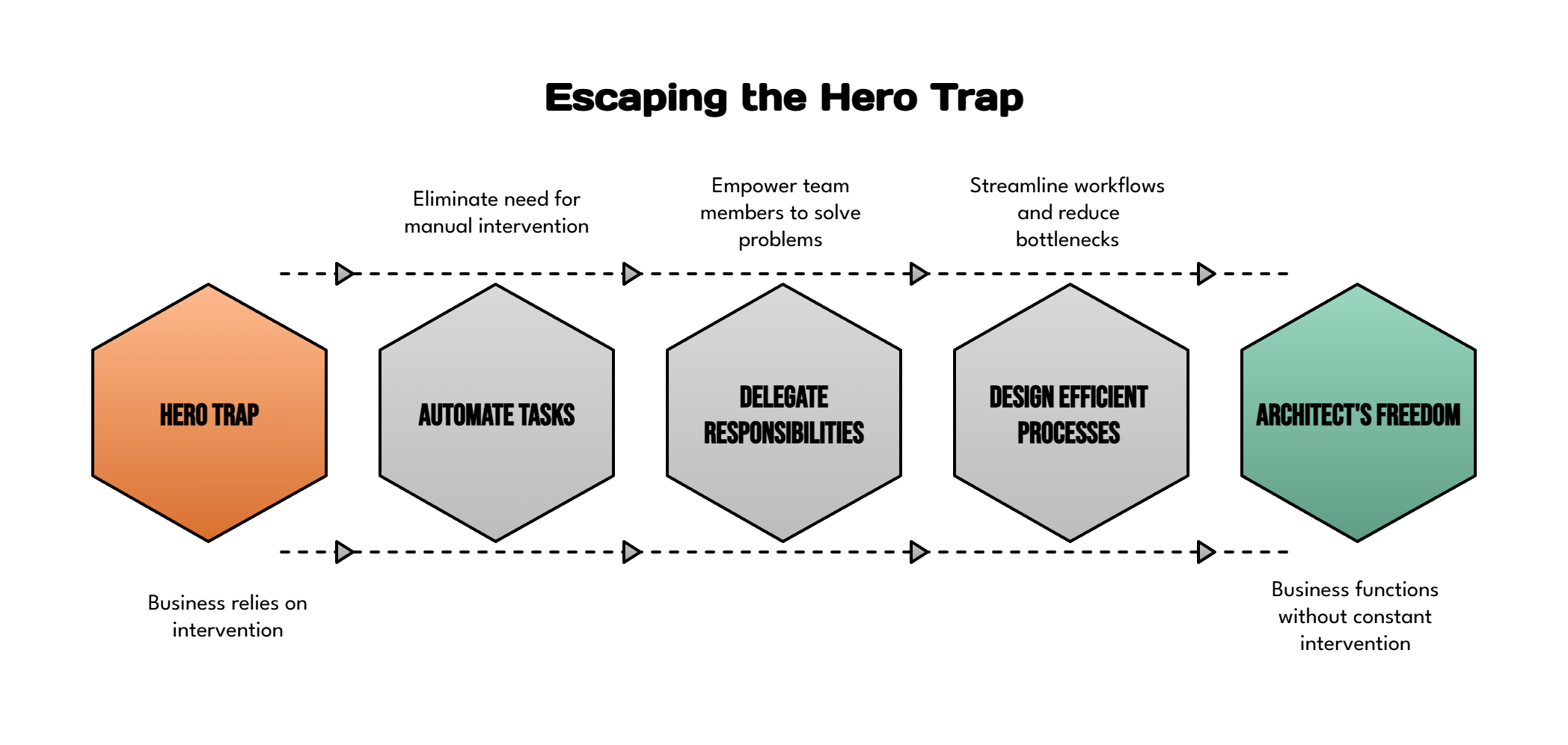
Systematic Execution vs Heroic Efforts – Escaping The Hero Trap
“Hustle” is often just a mask for lazy intellectual work. It is easier to answer a hundred emails than it is to build a system that eliminates the need for those emails to exist. It is easier to be the hero than the architect. The hero gets the glory today. The architect gets the freedom tomorrow.
Which one are you building for?
The Mediocrity Tax
The status quo is expensive.
When you operate in this “time management” mindset—constantly reacting, firefighting, juggling—you are paying a tax. We call it the Mediocrity Tax.
It doesn’t show up on your P&L. Your accountant won’t flag it. But it is bleeding you dry.
It’s the growth you miss because you were too busy handling operations to look at strategy.
It’s the talent you lose because high-performers don’t want to work in a chaotic environment where the CEO is the bottleneck.
It’s the valuation you kill because no smart investor buys a business that lives inside the founder’s head.
The Invisibility of Decay
The most dangerous part of this tax is its silence.
- The Visible Costs Of Heroic Efforts
Operational chaos is loud. You can hear the phones ringing and the deadlines swooshing by. But the decay of your potential is silent.
It looks like a flat revenue line. It looks like a “good enough” product. It looks like you, five years from now, looking in the mirror, greyer and more tired, realising you are exactly where you were five years ago—just moving faster to stay in the same place.
You are running on a treadmill, convinced you are climbing a mountain.
The Pivot: Physics Doesn’t Negotiate
Here is the Epiphany Bridge.
You are tired. You are overwhelmed. You feel like you are drowning in opportunity but starving for time.
This is not a character flaw. You are not “lazy” or “undisciplined.”
You are simply fighting physics. And physics does not negotiate.
You are trying to hold up a building with your bare hands. It doesn’t matter how strong you are; eventually, your muscles will fail. The answer isn’t to get stronger. The answer is to build a frame.
You need to stop managing the clock and start designing the environment.
The Solution: Enter The Triangle Advantage
The only way to escape the time trap is to replace Linear Effort with Structural Leverage.
We call this The Triangle Advantage.
It is not a theory. It is the observational physics of every scalable, durable business in history. It consists of three foundational legs that, when integrated, create a structure that holds itself up.
Human Capital: Not just “bodies,” but the right people in the right seats, empowered by culture, not command.
Systems: The documented, repeatable physics of how value is created.
Financial Intelligence: The dashboard that tells you the truth about your fuel and your speed.
When you lack one of these, you bleed time.
Weak Systems? You spend time correcting errors.
Weak Human Capital? You spend time micromanaging.
Weak Financials? You spend time worrying about cash flow.
But when you build all three? You get leverage.
From Renter to Architect
This requires a profound identity shift.
Right now, you are likely the Renter of your business. You live in it. You fix the leaky taps. You mow the lawns. You pay the rent with your sweat.
You must become the Architect.
The Architect does not lay the bricks. The Architect designs the blueprint. The Architect cares about the load-bearing walls, not the colour of the curtains.
Your new job is not to “do work.” Your job is to design the flow of work.
Every time a problem lands on your desk, your reaction should not be, “How do I solve this?” It should be, “Which part of the Triangle failed?”
Did a system break?
Did a person fail?
Did the data mislead us?
Fix the structure, and you solve the problem forever. Fix the instance, and you’ll see it again next Tuesday.
Systemic Liberty: Freedom is a Design Choice
There is a paradox here.
Entrepreneurs hate “bureaucracy.” They hate structure. They want freedom! So they reject systems, processes, and standardisation.
“Time is the only resource that vanishes the moment you receive it. The amateur tries to ‘save’ it. The professional invests it. An hour spent fighting a fire is an expense. An hour spent building a system is an asset that pays you back forever.”
And in doing so, they create their own prison.
Without structure, everything requires a decision. Everything requires you.
“How do we invoice this?” -> Ask the founder.
“What do I do if the client complains?” -> Ask the founder.
Structure creates liberty.
When you have a rigorous system (a “Triangle” foundation), the mundane is automated or delegated. The standard is maintained without your presence.
Boring? Maybe. Effective? Absolutely. Freeing? Incredibly.
Discipline creates the structure. Structure creates the freedom.
The Action Plan: The “Anti-Hustle” Protocol
Enough theory. You want your life back? You want to stop “managing time”? Here is the roadmap.
It requires courage. It requires you to say “no” to the dopamine hit of being the hero.
Step 1: Audit the Chaos (The Time Log)
You cannot engineer what you do not measure.
For three days, track every single thing you do. Not what you think you do. What you actually do.
“Spent 14 minutes formatting a font in Word.”
“Spent 45 minutes listening to a client vent about something my staff could have handled.”
“Spent 20 minutes looking for a password.”
It will be painful. It will be embarrassing. Do it anyway.
Step 2: Kill the “Zombie” Tasks
Look at that list. Apply the “Triangle Filter.”
Is this task generating revenue?
Is this task building a system?
Is this task developing a person?
If the answer is “no,” it is a Zombie Task. It is eating your brain for no nutritional value. Delete it. Do not delegate it. If it’s useless, don’t give it to someone else to waste their time. Just kill it.
Step 3: Architect the Flow
For the tasks that remain but shouldn’t be done by you:
Systemise it: Record a Loom video. Write a checklist. Create a template.
Delegate it: Hand the system (not just the task) to a human.
Trust the Physics: Let them fail once or twice. Correct the system, not the person.
The Final Verdict
Time management is a game for amateurs. It’s a hamster wheel with a gold-plated rim.
You don’t need to manage your time. You need to respect the physics of business. You need to build a machine that runs on systems, not on your adrenal glands.
Every minute you spend “hustling” to compensate for a lack of structure is a minute you are stealing from your future. You are stealing from the asset you are supposed to be building.
The choice is binary. You can continue to fight gravity. You can continue to wear your burnout like a badge of honour. Or, you can stop. You can step back. You can build the Triangle.
Build the structure, and the time will manage itself.
FAQ
Q1: “But I can’t delegate—nobody does it as well as I do.”
A: You are right. They won’t do it 100% as well as you. They might do it 80% as well. But if you have five people doing it 80% as well, you have 400% output. You are currently capped at 100%. Your perfectionism is a poverty mindset disguised as quality control. Build the system, and the “80%” will eventually become “110%.”
Q2: “I don’t have time to write systems. I’m too busy working.”
A: This is like saying, “I’m too busy driving to stop and get petrol.” Eventually, the car stops. You are not “too busy”; you are unprioritised. You must invest time to buy time. Take one hour a day. That one hour of system-building will pay you back thousands of hours over the lifetime of your business. It is the highest ROI activity you can do.
Q3: “What if my team resists the structure?”
A: High performers love structure because it removes ambiguity and lets them win. Low performers hate structure because it exposes their hiding spots. If your team resists clarity, you don’t have a systems problem; you have a Human Capital problem. The Triangle reveals the truth. Don’t hide from it.