

The Seven Talent Repellents: What Your Best Candidates See That You Don’t
The Uncomfortable Truth About Your “Talent Problem”
Here’s a story you’ve probably told yourself: “We just can’t compete with the big guys for top talent. They’ve got the budgets, the brand names, the fancy offices with the ping pong tables and the craft coffee.”
It’s a comforting story. It absolves you of responsibility. It makes your talent struggles feel like an inevitability rather than a choice.
It’s also complete rubbish.
The uncomfortable truth? A-players aren’t avoiding your small business because you can’t match Google’s compensation package. They’re avoiding you because you’ve built an environment that actively repels them. You’ve created what I call a Talent Repellent Zone—and you don’t even know it.
The even more uncomfortable truth? Your business is probably doing this right now, and the A-players who could transform your operation can smell it from a mile away.
Let me explain.
The Talent Perception Gap: The Disconnect That’s Costing You Everything
There’s a fascinating phenomenon I’ve observed in thousands of conversations with business owners. When asked why they struggle to attract top talent, they almost universally point to external factors:
“We can’t pay enough.” “We don’t have the brand recognition.” “The job market is too competitive.” “Millennials just don’t want to work anymore.”
Meanwhile, when you ask A-players why they rejected opportunities at small businesses, you get a completely different story:
“I couldn’t figure out what winning actually looked like there.” “Everyone seemed to be running in different directions.” “The owner couldn’t articulate where the company was going.” “I asked about growth opportunities and got a lot of vague hand-waving.”
This is the Talent Perception Gap—the chasm between how business owners view their talent challenges and what actually drives A-players’ decisions.
Business owners see a resource problem. A-players see an “environment” problem.
Business owners think they’re losing on compensation. A-players are screening for something else entirely—something that most small business owners have never even considered.
Here’s the brutal reality: A-players have options! They can work anywhere. They’re evaluating you just as rigorously as you’re evaluating them. And their evaluation criteria isn’t what you think it is.
They’re not comparing your salary to your competitor’s salary. They’re comparing your environment to the environment where they could do their best work. And most small businesses fail this test spectacularly.
The Seven Talent Repellents: What’s Actually Driving High Performers Away
Through extensive research and pattern recognition across hundreds of organisations, I’ve identified seven environmental factors that consistently repel top talent. Think of these as the organisational equivalent of industrial-strength bug spray—except instead of keeping mosquitoes away, you’re keeping away the exact people who could transform your business.
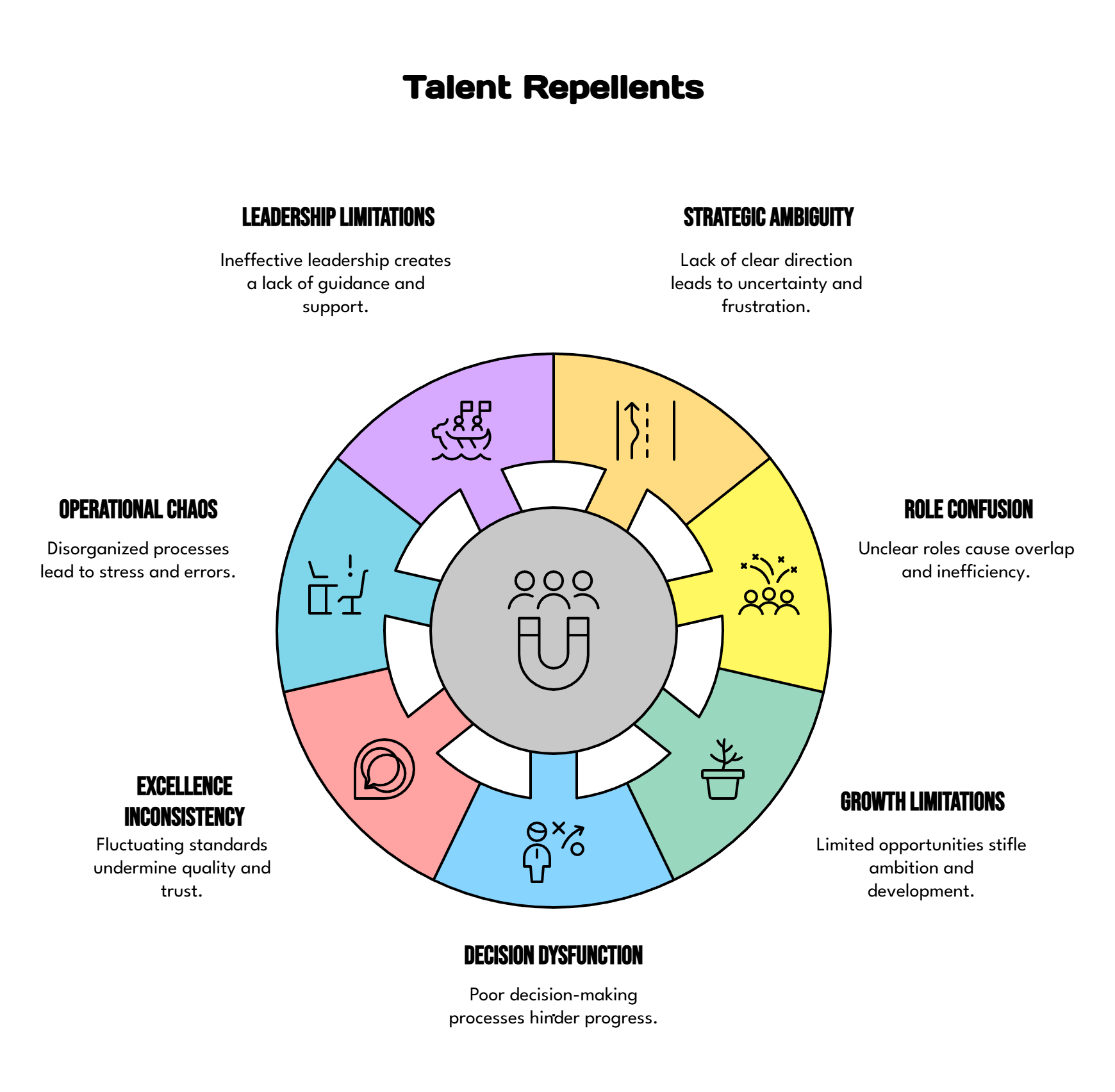
Is Your Business Spraying Talent Repellant?
1. Strategic Ambiguity: The Fog of War (Without the War)
Nothing sends an A-player running faster than the question: “What’s your strategy?” followed by fifteen minutes of meandering non-answers.
Strategic ambiguity means a lack of clear direction. It’s when everyone in the organisation has a different answer to “What are we trying to accomplish?” It’s when the vision changes with every market fluctuation or competitor move. It’s when employees can’t explain the company’s priorities because the leadership can’t explain them either.
A-players crave clarity. They want to know where the ship is heading so they can figure out how to help it get there faster. When you can’t tell them where you’re going, you’re essentially asking them to row blindly in the dark. That’s not a compelling proposition for anyone with options.
The tell-tale sign: When you ask three different team members what the company’s top priority is this quarter, you get three different answers.
2. Role Confusion: The Accountability Void
“We’re a flat organisation! Everyone does everything!”
Translation: Nobody is responsible for anything specific, so nothing gets done well.
Role confusion manifests as unclear responsibilities and expectations. It’s the murky space where tasks fall through cracks because everyone assumes someone else is handling them. It’s the environment where high performers can’t tell if they’re succeeding because success was never defined.
A-players want to own outcomes. They want clear accountability. They want to know exactly what’s expected of them so they can exceed those expectations. When everything is everyone’s responsibility, nothing is anyone’s responsibility—and A-players know this is a recipe for frustration.
The tell-tale sign: Projects frequently stall because no one knows who has decision rights, or the same decisions get made multiple times by different people.
3. Growth Limitations: The Career Cul-de-Sac
Here’s something small business owners rarely consider: A-players aren’t just evaluating the job you’re offering. They’re evaluating the trajectory you’re offering.
Growth limitations mean stagnant career development. It’s when there’s no clear path forward, no skill development opportunities, no expanding responsibilities. It’s when the message—spoken or unspoken—is “this job will look exactly the same in three years as it does today.”
Top performers are growth-obsessed. They’re constantly asking themselves: “Am I learning? Am I expanding? Am I becoming more valuable?” When your environment answers “no” to these questions, you’ve lost them—even if they haven’t left yet.
The tell-tale sign: You can’t articulate what the “next level” looks like for any given role, or worse, you’ve never thought about it.
4. Decision Dysfunction: The Paralysis Tax
A-players want to make things happen. They want to see their ideas implemented, their initiatives launched, their contributions manifested in real outcomes.
Decision dysfunction—inefficient and ineffective decision-making—is the kryptonite to this drive. It’s when simple decisions require seventeen meetings. It’s when everything has to go through the owner, who’s too busy fighting fires to respond. It’s when analysis paralysis has become the default operating mode.
Every day of decision delay is a day of A-player frustration. They came to make an impact, and you’ve built an environment where impact is bureaucratically impossible.
The tell-tale sign: You have a mental list of “obvious” improvements that everyone agrees should happen, but somehow never do.
5. Excellence Inconsistency: The Standards Carousel
Nothing demoralises a high performer faster than watching mediocrity get tolerated—or worse, rewarded.
Excellence inconsistency means uneven quality of work. It’s when standards shift depending on who’s doing the work or who’s evaluating it. It’s when exceptional work gets the same recognition (or criticism) as adequate work. It’s when the message is “good enough is good enough.”
A-players are allergic to environments where their excellence is averaged down by the tolerance of mediocrity. They want to be surrounded by other excellent people, held to high standards, and recognised when they exceed them. When you can’t provide that, they’ll find someone who can.
The tell-tale sign: You have team members whose subpar work everyone compensates for rather than addresses.
6. Operational Chaos: The Firefighting Addiction
Some businesses wear their chaos like a badge of honour. “We’re fast-moving! We’re agile! We’re in startup mode!”
Here’s what A-players hear: “We have no idea what we’re doing, and we’ve dressed it up in Silicon Valley jargon.”
Operational chaos—disorganised and inefficient processes—means that every day is an exercise in reinventing wheels that should have been built once and used forever. It’s the environment where tribal knowledge rules, where documentation doesn’t exist, where every task feels harder than it should be because nothing is systematised.
A-players want to do exceptional work on exceptional problems. They don’t want to spend their cognitive capacity figuring out how to do basic things because no one ever bothered to create a process. That’s not engaging—it’s exhausting.
The tell-tale sign: New hires take twice as long as they should to become productive because there’s no structured onboarding or documented processes.
7. Leadership Limitations: The Ceiling Effect
This one’s personal, and it’s probably the most important.
Leadership limitations mean ineffective guidance and support. It’s when leaders can’t coach, can’t develop, can’t inspire. It’s when the leadership team creates more problems than they solve. It’s when working for the boss is something to be endured rather than something to be valued.
A-players have usually worked with great leaders somewhere in their career. They know what good leadership feels like. They know how it accelerates their development, expands their capabilities, and amplifies their impact. When they sense leadership limitations, they know they’re signing up for a ceiling on their own potential.
The tell-tale sign: When asked what they’re learning from leadership, team members draw a blank or give generic answers.
The Compensation Myth: Why Money Can’t Buy You A-Players
Now let’s address the elephant in the room: compensation.
Yes, you need to pay competitively. Yes, A-players command premium compensation. But here’s what the compensation-obsessed miss: money is table stakes, not a differentiator.
Consider this: A-players are, by definition, people who could earn excellent compensation almost anywhere. They have options. They’re in demand. So when they’re evaluating opportunities, compensation becomes a qualifier rather than a decider. It gets you into the consideration set—it doesn’t win you the talent.
What wins you the talent is the environment. The growth. The impact potential. The leadership quality. The operational excellence. All the things we just talked about.
I’ve seen countless small businesses lose A-players to competitors offering less money because those competitors offered something more valuable: an environment where the A-player could do their best work.
Think about it from the A-player’s perspective. Would you rather earn $120,000 in an environment where you’re frustrated, limited, and unable to make an impact? Or $110,000 in an environment where you’re learning, growing, and creating real value?
The math isn’t even close.
This is actually good news for small businesses. You might not be able to match the compensation packages of large enterprises. But you absolutely can build an environment that attracts A-players—if you’re willing to do the work.
The Small Business Advantage: Your Hidden Talent Magnets
Here’s the plot twist: small businesses actually have natural advantages in the talent game. You’re just probably not leveraging them.
Purpose Visibility
In a small business, the connection between individual contribution and organisational impact is direct and visible. An A-player can see how their work moves the needle. In a large enterprise, that connection gets diluted across thousands of employees and countless layers of abstraction.
The advantage: A-players want to matter. Small businesses can offer meaning that enterprises can’t.
Decision Velocity
When a small business gets its act together, it can move incredibly fast. No bureaucracy, no committee approvals, no waiting for headquarters to sign off. Ideas can become reality in weeks rather than quarters.
The advantage: A-players want to make things happen. Small businesses can offer speed that enterprises structurally cannot.
Role Expansion
In a small business, roles are fluid. A-players can expand into adjacent areas, take on new challenges, and rapidly build diverse skill sets. Try that in a large enterprise with its rigid role definitions and territorial departments.
The advantage: A-players want to grow in multiple dimensions. Small businesses can offer breadth that enterprises rarely allow.
Innovation Opportunity
Small businesses can pivot, experiment, and innovate without the constraints of legacy systems, established processes, and institutional inertia. An A-player can drive real innovation rather than incremental improvements.
The advantage: A-players want to create, not just optimise. Small businesses can offer creative freedom that enterprises crush.
Leadership Accessibility
In a small business, an A-player can work directly with senior leadership, learn from them, influence them, and be influenced by them. In a large enterprise, leadership is an abstract concept encountered primarily through all-hands emails.
The advantage: A-players want mentorship and influence. Small businesses can offer leadership access that enterprises cannot.
These advantages are real and substantial. But here’s the catch: they only work if you’ve eliminated the Seven Repellents first. No amount of “purpose visibility” compensates for operational chaos. No “decision velocity” matters if every decision is made poorly.
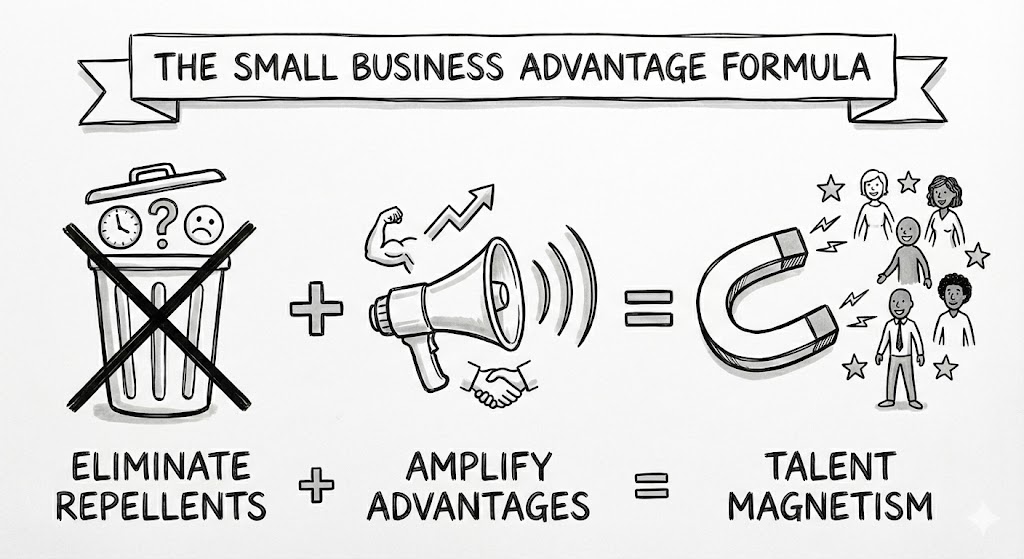
The formula is simple: Eliminate repellents + Amplify advantages = Talent magnetism.
The Talent Magnetism Audit: A Practical Tool for Self-Assessment
Before you can transform your environment, you need to understand where you actually stand. Here’s a practical audit you can conduct with your leadership team. Just do it and thank me later.
For each of the following statements, rate your organisation honestly from 1 (strongly disagree) to 5 (strongly agree):
Strategic Clarity
- Every team member can clearly articulate our top three priorities
- Our strategy has been consistent for at least six months
- We have a documented vision that guides decision-making
Role Definition
- Every role has clearly documented responsibilities and success metrics
- There’s no confusion about who owns what decisions
- Handoffs between roles are smooth and well-defined
Growth Pathways
- Every team member has a documented development plan
- We invest meaningfully in training and skill development
- There are clear advancement opportunities for high performers
Decision Effectiveness
- Routine decisions are made quickly without unnecessary escalation
- We have clear frameworks for making different types of decisions
- Decisions, once made, are communicated and implemented promptly
Excellence Standards
- We have clear, consistent standards for quality of work
- Poor performance is addressed promptly and constructively
- Exceptional performance is recognised and rewarded
Operational Excellence
- Core processes are documented and consistently followed
- New team members can become productive quickly
- We spend more time on strategic work than on firefighting
Leadership Quality
- Our leaders actively develop their team members
- Leadership decisions are generally respected and trusted
- Team members feel supported and guided by their leaders
Scoring:
- 21-35: Critical – You’re actively repelling A-players
- 36-50: Developing – You have significant improvement opportunities
- 51-65: Emerging – You’re making progress, but have gaps
- 66-80: Strong – You’re attractive to most A-players
- 81-105: Exceptional – You’re a talent magnet
Most small businesses score in the Critical to Developing range!!!
Now they know why their “talent problem” won’t be solved by better job postings or higher salaries.
Case Study: The Engineering Firm That Became a Talent Magnet
Let me tell you about a mid-sized engineering firm in Newcastle that came to us with a familiar complaint: “We can’t attract good engineers. They all want to work for the big firms.”
During the Talent Magnetism Audit, they scored 29. Critical.
Here’s what we found:
Strategic Ambiguity: The firm had three different “strategic priorities” depending on which partner you asked. Engineers didn’t know whether to focus on efficiency, innovation, or client satisfaction.
Role Confusion: Project responsibilities were assigned informally and inconsistently. Engineers routinely found themselves duplicating work or missing critical tasks because ownership was unclear.
Growth Limitations: There was no professional development program. Engineers who wanted to grow their skills had to do it on their own time with their own money.
Decision Dysfunction: Every significant decision went to the partners, who were perpetually overloaded and took weeks to respond to even simple requests.
Excellence Inconsistency: Some engineers produced exceptional work; others delivered barely adequate output. Both received similar treatment.
Operational Chaos: Every project was approached differently. There were no standard processes, no documentation, no institutional knowledge capture.
Leadership Limitations: Partners were excellent engineers but had never developed as leaders. They managed through task assignment rather than through development.
The transformation took eighteen months. Here’s what they did:
Month 1-3: Strategic clarity. The partners locked themselves in a room until they agreed on a coherent strategy. They documented it, communicated it, and began using it to guide every decision.
Month 3-6: Role definition. Every role in the firm was documented with clear responsibilities, success metrics, and decision rights. They created an accountability chart that eliminated ambiguity.
Month 6-9: Decision frameworks. They established clear protocols for different decision types. Routine decisions were pushed to appropriate levels. Only strategic decisions required partner involvement.
Month 9-12: Operational excellence. They documented core processes, created standard project management approaches, and built a knowledge base. New engineers could now become productive in weeks rather than months.
Month 12-15: Leadership development. Partners invested in developing their coaching and mentoring capabilities. They established regular one-on-ones focused on development rather than just task review.
Month 15-18: Excellence culture. They implemented a performance management system with clear standards. High performers were recognised; underperformers were coached or moved out.
The results? Within two years:
- Voluntary turnover dropped from 28% to 9%
- They received 5x more qualified applications per opening
- They successfully recruited three senior engineers from larger firms
- Revenue per employee increased 34%
- Their Talent Magnetism Audit score improved from 29 to 74
The most telling indicator? In their latest hire’s interview, when asked why she chose this small firm over a major engineering consultancy, she said: “This place feels like somewhere I can actually do great work.”
That’s the transformation. From “we can’t compete” to “this is where A-players want to be.”
The Magnetism Mindset: The Fundamental Shift
xyz
The journey from talent repellent to talent magnet requires more than tactical changes. It requires a fundamental shift in how you think about talent.
The old mindset: “How can we find people willing to work here?” The new mindset: “How can we create an environment where A-players want to be?”
The old mindset: “We need to hire our way out of our problems.” The new mindset: “We need to become the kind of place that attracts problem-solvers.”
The old mindset: “Top talent is too expensive for us.” The new mindset: “Top talent is too valuable to repel.”
This shift is uncomfortable because it puts the responsibility squarely on your shoulders. You can no longer blame the market, the competition, or the workforce. Your talent results are a direct reflection of your environment choices.
But this shift is also liberating. Because if your talent problems are environmental, they’re solvable. You have agency. You can change.
The Final Word: Going Far Together
There’s an African proverb that captures the essence of what we’ve discussed:
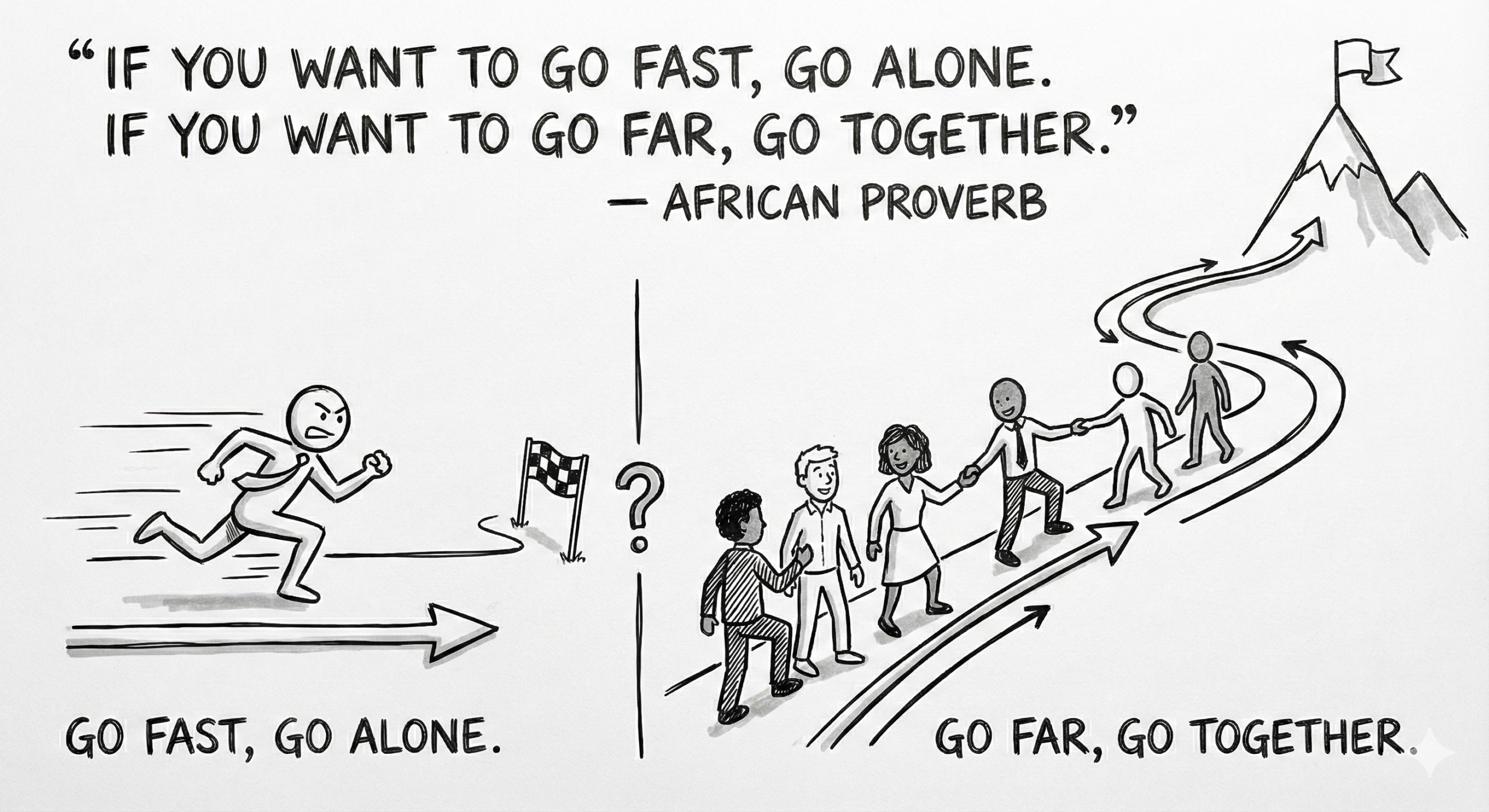
“If you want to go fast, go alone. If you want to go far, go together.” — African Proverb
“If you want to go fast, go alone. If you want to go far, go together.”
Most small business owners have internalised the first half. They’re running fast, alone, handling everything themselves because they “can’t find good people.”
But here’s the truth: they’ve built environments that guarantee they’ll always be alone. They’ve created talent repellent zones that ensure they’ll never attract the team that could take them far.
The opportunity—and it is an opportunity—is to flip the equation. To build an environment that attracts A-players. To create a place where exceptional people want to work. To assemble a team that can achieve things you never could alone.
This isn’t about ping pong tables or unlimited vacation days or any of the other superficial perks that companies mistake for culture. It’s about the fundamentals: clarity, growth, excellence, decision quality, operational competence, and leadership development.
Get these right, and you’ll discover something remarkable: the talent shortage you thought was an external reality was actually an internal choice. One you can unmake, starting today.
The A-players are out there. They’re looking for somewhere to do their best work.
The question is: Will they find it when they look at you?
Your Next Move
You have a choice. You can continue telling yourself that your talent problems are someone else’s fault—the market, the competition, the entitled workforce.
Or you can conduct an honest Talent Magnetism Audit, identify your repellents, and begin the systematic work of transforming your environment.
The engineering firm in Newcastle made their choice. They stopped blaming external factors and started building internal excellence. Today, they have their pick of talent.
What will you choose?