

Three financial intelligence shifts that separate businesses built to survive from businesses built to look good on paper
By Vladan Nikolic, Founder, Effecta Consulting
Introduction: The Accounting Illusion
The business was profitable every year it existed. It also ran out of cash. Both things are true.
This is not unusual. It is, in fact, a design failure.
The conversation usually goes like this: the accountant presents the annual figures, the numbers look solid, the owner nods. They’ve worked hard, invoiced consistently, grown their revenue. Twelve months later, they’re deferring their own wage to make payroll. Not because the business failed. Because the money that was theoretically theirs was sitting somewhere between an outstanding invoice and a supplier payment term they didn’t negotiate well enough.
For Australian SME trades businesses, this is not a fringe scenario. It is the dominant financial experience. The builder turning over $3M who can’t take a holiday because the cash position is too uncertain. The electrician doing $1.8M in revenue who discovers in February that the packed forward work schedule doesn’t translate into a bank account he can actually run a business from. You can be profitable and broke simultaneously. The mechanism is not complicated. The consequences are catastrophic. And the fix is structural — not motivational, not accounting-driven, and not solved by working harder.
Here’s what this piece will do: diagnose the design failure precisely, dismantle the beliefs that keep it in place, and give you three Financial Intelligence shifts that close the gap between paper profit and operational cash. Permanently.
The Mechanics of the Profit-Cash Gap
Why Your P&L Is a History Lesson, Not a Health Report
Accrual accounting — the method your accountant uses to produce your financial statements — records revenue when an invoice is issued, not when cash is received. It records an expense when it’s incurred, not when it’s paid. The result is a profit figure that is, by design, detached from your real-time cash position.
For a builder who invoices a $400,000 project on completion and collects 60 days later, the revenue appears on this month’s P&L. The cash arrives in two months. In the intervening period, materials have been paid, subbies have been paid (or are waiting to be paid), and the owner’s bank account is running on the previous project’s receipts — which are themselves subject to the same 60-day lag.
This is not a problem with the accountant. It is a structural feature of how trades businesses are financed — and how few owners understand the implications.
“Profit is not the purpose of a business, but rather the test of its validity.” — Peter Drucker
That quote lands differently in this context. If profit is merely the test of validity, then cash is the operating reality. A business that can pass the validity test but fails the operational reality test is structurally compromised, regardless of what the P&L says.
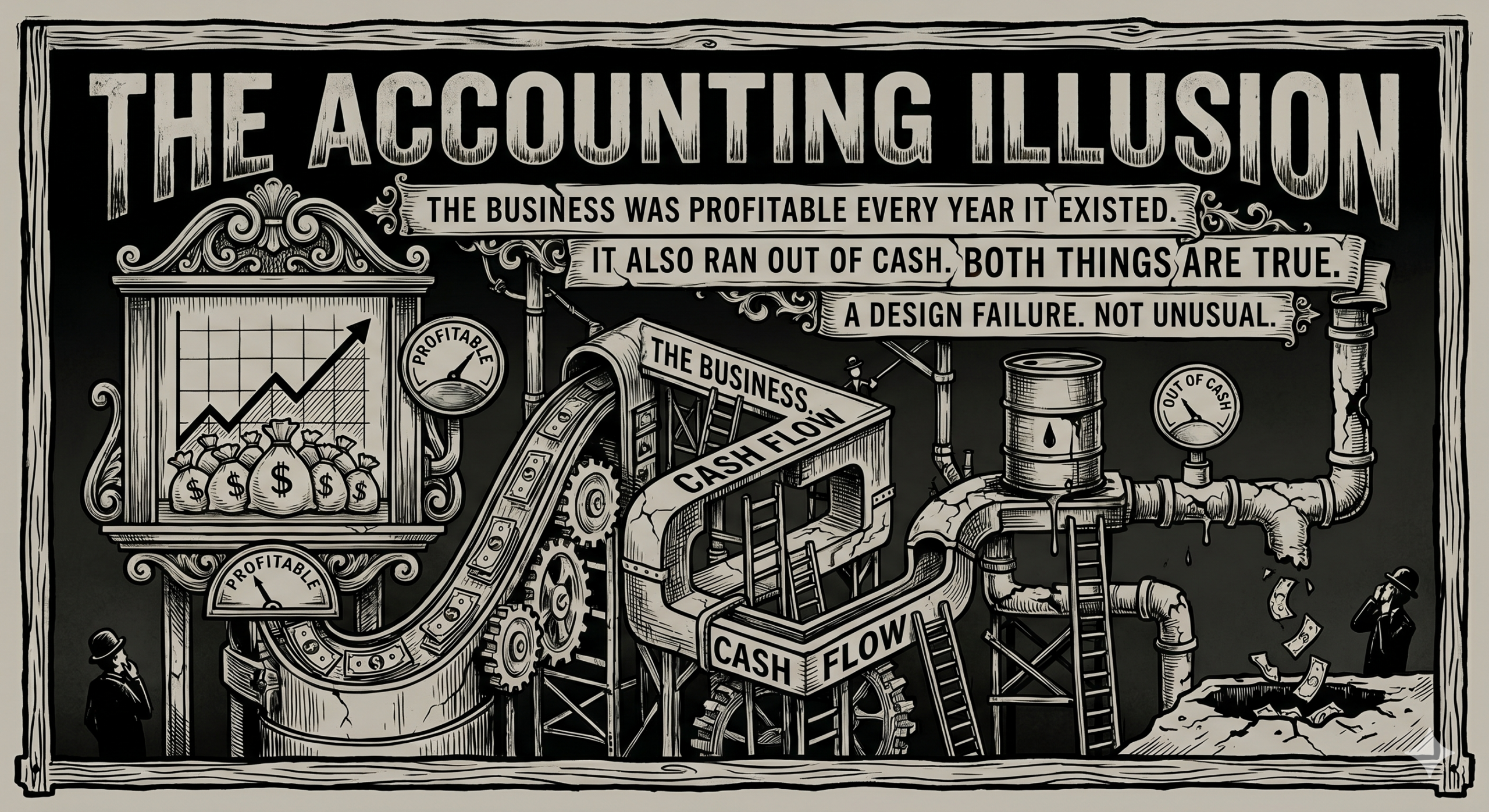
The Great Accounting Illusion – A Design Failure.
The average debtor days for Australian construction and trades businesses sits between 52 and 67 days. A business turning over $2M in revenue with a 60-day debtor cycle has approximately $330,000 perpetually tied up in outstanding invoices at any given moment. That $330,000 is real money. It is owed to the business. It is earning no interest, funding no operations, and sitting as an invisible asset that most owners have never formally quantified.
“A business turning over $2M with a 60-day debtor cycle has $330,000 permanently locked in outstanding invoices. That money exists. It just doesn’t exist where you can use it.”]
The Cash Conversion Cycle: The Number You’ve Never Calculated
The Cash Conversion Cycle (CCC) measures precisely how long it takes for a dollar invested in the business to return as cash. The formula: Days Sales Outstanding, plus Days Inventory Outstanding, minus Days Payable Outstanding.
Most SME owners have never calculated this. That is not a moral failing. It is a structural gap in the Financial Intelligence pillar — and a gap that compounds silently.
A trades business with a 70-day CCC needs to finance 70 days’ worth of operational expenditure from working capital before it sees a return on that investment. As revenue grows, this financing requirement grows proportionally. Scaling a business with a long CCC without understanding the working capital implications is not growth. It is acceleration toward a structural cash crisis.
“Tell me how you measure me, and I will tell you how I will behave.” — Eliyahu Goldratt
When an SME owner measures financial health purely by revenue and profit, the business is designed to perform on those two metrics — regardless of what’s happening to cash. The measurement creates the blind spot.
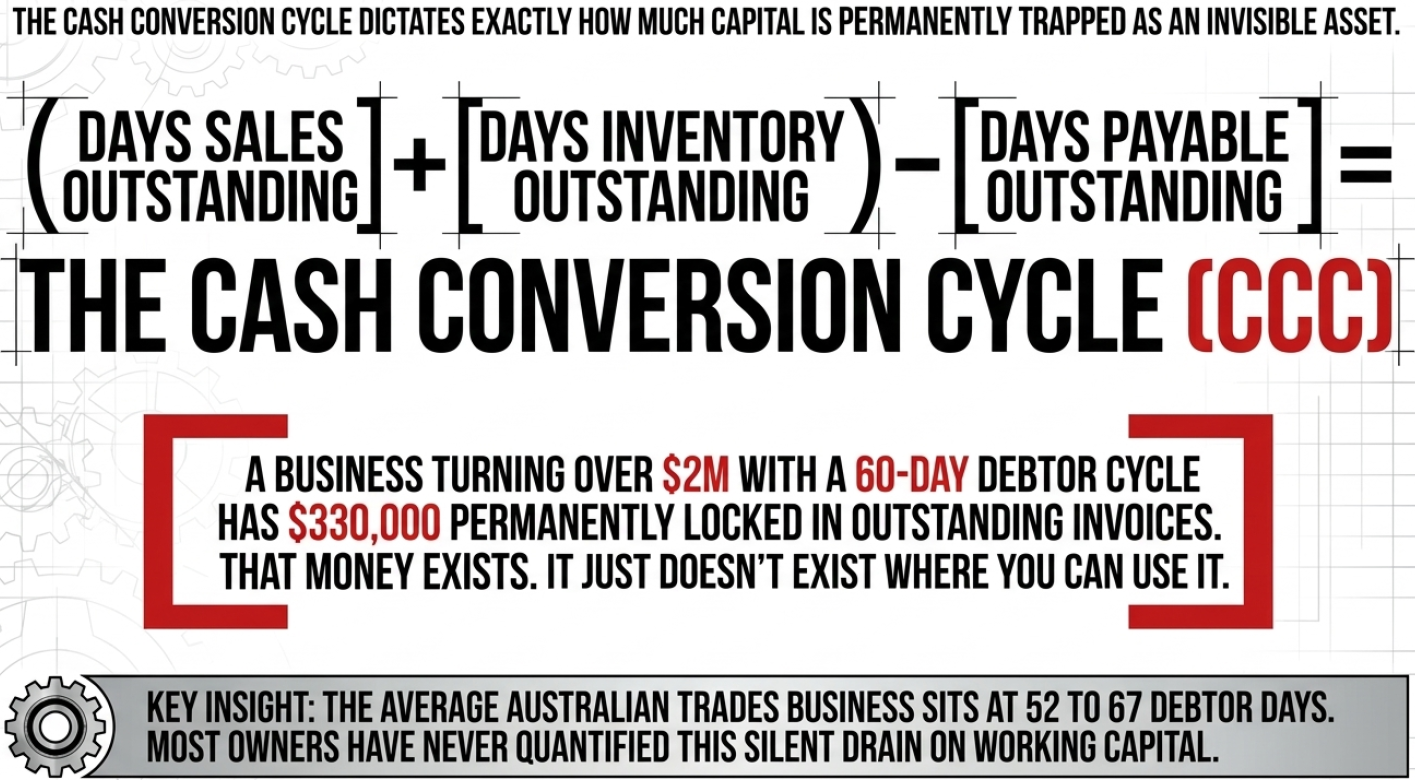
Cash Conversion Cycle
The Five Beliefs That Keep Profitable Businesses Structurally Broke
False Belief 1: “Profit Means We’re Safe”
Profit is an accounting residual. It tells you the mathematical difference between revenue and expenses over a period — using accounting rules, not cash movements. Safety, in operational terms, is measured by cash: the ability to meet obligations as they fall due, and the working capital buffer available when a client delays payment or a project overruns.
A business is not safe because it is profitable. It is operationally safe because it understands and manages its cash timing. These are not the same thing. Most SME owners have spent years confusing them.
False Belief 2: “More Revenue Will Solve It”
This is the most expensive misconception in SME finance. Revenue growth with a broken cash conversion cycle does not fix the problem. It accelerates it.
More revenue means more invoices. More outstanding invoices means more working capital tied up in receivables. If the debtor cycle stays at 60 days and revenue doubles, the cash permanently locked in outstanding invoices also doubles. You have scaled the structural problem, not solved it.
“Profit on paper doesn’t always translate to cash in hand.” — Celeste Advisory, 2026
The instinct to grow out of a cash problem is understandable. It is almost always wrong. Growth is a lever. Working capital management is the architecture that determines whether that lever creates value or creates crisis.
False Belief 3: “The Accountant Is Watching This”
The accountant is watching the past. Their primary function is to produce accurate historical financial statements, meet reporting obligations, and manage your tax position. These are valuable services. They are not the same as forward-facing financial intelligence.
Backward-facing financials are a history lesson. Forward-facing financial intelligence is a survival instrument. Both matter. Most trades businesses only have one.
False Belief 4: “A Packed Schedule Equals Financial Health”
A full forward work schedule is not a cash reserve. It is a pipeline of future invoices that have not yet been issued, collected, or converted to usable cash. The tradesperson who is booked four months forward and cannot make payroll this Friday has not misunderstood the market. They have misunderstood the relationship between a schedule and a bank account.
Busyness is not financial health. Without the right architecture, it is the illusion of health — which is more dangerous than obvious financial distress, because it delays the intervention.
False Belief 5: “This Is a Cash Flow Problem”
It isn’t. That framing is too narrow, and it points to the wrong fix. Cash flow is a symptom. The underlying condition is a Financial Intelligence pillar failure — a structural absence of the systems, visibility, and forward-looking instruments that would prevent cash crises from occurring in the first place.
The Triangular Advantage OS treats Financial Intelligence as a design requirement, not an accounting function. The question is not “how do we manage cash flow?” The question is “how do we build a business whose financial architecture makes cash crises structurally improbable?”
BRUTAL TRUTH: • You can be profitable and insolvent simultaneously. Australian courts have confirmed this. Thousands of times.
- The P&L your accountant produces tells you about last period. It tells you almost nothing about next month.
- Revenue growth without working capital design does not solve cash problems — it amplifies them.
- “I didn’t know it was this bad” is the most expensive sentence in SME finance. The information was always there. The system to interpret it wasn’t.
- Most trades businesses are one major payment delay away from a crisis. That is not a cash flow problem. It is an architecture problem.
The Cost of Getting This Wrong: 90 Days, 12 Months, 3 Years
90 Days
The first symptom is usually quiet. An invoice that runs 75 days instead of 45. A supplier payment pushed by a week. The owner covers a payroll gap with a personal credit card, intending to sort it out next month. Subcontractor payments are prioritised based on who’s asking loudest, not who’s owed the most.
These are not financial crises. They are structural warnings — the first signals that the cash conversion architecture is under strain. Owners who miss them as warnings experience them later as emergencies.
12 Months
Twelve months in, the pattern is entrenched. The business has its best revenue year on record. The owner has drawn an inconsistent wage. The bank account oscillates between relative comfort after a major payment and genuine anxiety before the next one. The owner has learned the rhythm but not the system.
They know which months are hard. They don’t know why. They can’t predict it reliably enough to plan around it. They are running a $2M business on intuition and experience where they need data and architecture.
“A business whose owner cannot tell you, within two weeks, when they will next face a cash shortfall does not have a financial intelligence system. It has a series of near-misses they’ve normalised.” — Vladan Nikolic
3 Years
Three years of operating without Financial Intelligence pillar infrastructure creates a structural ceiling. The business cannot take on larger projects without cash anxiety. It cannot negotiate better supplier terms because it has no working capital leverage. It cannot invest in the Human Capital or Systems pillars because every dollar of discretionary cash is deployed reactively, not strategically.
The business is not failing. It is trapped. And the trap was built, quietly, from the belief that profit was the same thing as financial health.
The Structural Fix: Three Financial Intelligence Shifts
This is where the gap analysis work matters. The following three shifts are not equally weighted for every business. One of them is your Primary Constraint right now — the one that, if resolved, changes everything downstream. Identifying which one requires a diagnostic lens. What follows is the architecture; where you start within it is specific to your structure.
Shift 1 — From Backward-Facing to Forward-Facing
Replace the monthly P&L review as your primary financial instrument with a rolling 13-week cash flow forecast. This is not a budget. A budget is a plan. A 13-week cash forecast is a visibility instrument — it shows you exactly when cash enters and exits the business, week by week, 13 weeks ahead.
Build it once, update it weekly. It takes 90 minutes the first time and 20 minutes every subsequent week. It will tell you more about your business’s financial reality than any financial statement you’ve ever received.
The business that runs a 13-week rolling forecast is never surprised by a cash shortfall. Surprises require blindness. This removes the blindness.
“The most dangerous question an SME owner cannot answer is: ‘What does your cash position look like in six weeks?’ If the answer is ‘I’d have to check,’ the business is flying blind.” — Vladan Nikolic
Shift 2 — Calculate and Manage Your Cash Conversion Cycle
Know your CCC. Calculate it. Then manage it — intentionally, systematically, and as a strategic priority rather than an accounting afterthought.
Every day you reduce your CCC by one day is working capital freed back into the business. For a $2M revenue business, one day’s improvement in debtor turnaround is approximately $5,500 in freed cash. Fifteen days of improvement — achievable within a structured receivables system inside 90 days — is $82,000 returned to operational use without winning a single new client.
This is not an accounting improvement. It is a structural redesign of how the business finances itself.
Shift 3 — Systemise Your Receivables
Chasing invoices is not a financial strategy. It is a symptom of a system that doesn’t exist.
Build the receivables system: invoice at project milestones, not at the owner’s convenience. Send statements at day 14. Follow up at day 28. Escalate at day 35 with a documented process. Enforce terms at day 45. This is not aggressive — it is professional. Businesses that operate this system consistently reduce debtor days by 15–25 days within a quarter.
At $2M revenue, that is $80,000 to $140,000 released back into operations. No new clients. No new revenue. Just better architecture applied to money the business had already earned and was owed.
The Epiphany: What Forward-Facing Financial Intelligence Actually Means
You’ve probably been treating your P&L as a health report. It isn’t. It’s a history lesson. A well-formatted, technically accurate, legally compliant history lesson about a period of time that has already passed.
The shift from backward-facing to forward-facing financial intelligence is not primarily a technical shift. It is a conceptual one. Once you see that profit is what your business produced last period, and cash is what your business needs to operate this period and next period, the instruments you need become obvious.
You stop asking “were we profitable?” You start asking “when does cash arrive, when does it leave, and what is the gap between those two events that I need to fund?”
That question is the beginning of Financial Intelligence. Everything that follows — the 13-week forecast, the CCC calculation, the receivables system — is structure applied to that clarity.
“Profit is what your business produced last period. Cash is what your business needs to operate next period. Confuse them, and you will eventually be profitable and broke simultaneously.”
Financial Intelligence Failures: The Problem/Benefit Table
| # | Structural Problem | Benefit if Resolved | First Action (30 Days) |
|---|---|---|---|
| 1 | No 13-week cash flow forecast — owner is regularly surprised by shortfalls | Predictable cash position; decisions made from data, not anxiety | Build the forecast template and populate it with known receivables and fixed costs this week |
| 2 | Cash Conversion Cycle unknown — growth is scaling a hidden working capital problem | Every dollar of growth is financed more efficiently; borrowing requirements reduced | Calculate CCC for the last 12 months; identify where the longest delays occur |
| 3 | Receivables managed reactively — invoices chased when cash is tight, not systematically | Debtor days reduced by 15–25 days; $80K–$140K freed at $2M revenue | Document the current receivables process; identify the first missing trigger point |
| 4 | Monthly P&L used as the primary financial instrument | Forward-looking financial decisions replace reactive ones | Replace the monthly P&L review with weekly cash position review plus rolling forecast |
| 5 | Profit mistaken for financial health; busyness mistaken for safety | Owner reads the business accurately; strategic decisions replace survival decisions | Run the Triangular Financial Intelligence diagnostic to identify the Primary Constraint |
Your 30-Day Financial Intelligence Plan
- Build the 13-week rolling cash flow forecast. Revenue timing by project and invoice date, all fixed costs, variable costs, and tax provisions. This is the single most useful financial instrument your business doesn’t have yet.
- Calculate your Cash Conversion Cycle. Three numbers: average days to collect invoices, average inventory holding time, average days to pay suppliers. The formula is straightforward. The insight it produces is significant.
- Audit your receivables right now. What is your current average debtor days? How many invoices are outstanding beyond 45 days? What is the total dollar value locked in outstanding receivables at this moment?
- Map the working capital gap. Calculate how many dollars of working capital you need to carry per $100,000 of revenue at your current CCC. That number tells you your structural financing requirement — and whether you’re currently funding it from operations, credit, or luck.
- Run the Triangular Diagnostic — Financial Intelligence pillar. Identify which of the three structural failures above is your Primary Constraint right now. Don’t attempt to address all three simultaneously. Address the one that’s choking the business first.
The Question That Should Bother You
Here is a diagnostic question. Not rhetorical. Genuinely diagnostic.
If your three biggest clients simultaneously delayed payment by 30 days — not defaulted, just a 30-day timing shift — what would happen to your business?
If the answer is “we’d be fine,” your Financial Intelligence architecture is working. If the answer involves deferred wages, delayed supplier payments, or a personal credit card, then what you experienced in that moment of calculation is the structural vulnerability the business is carrying, silently, every single day.
Most owners answer this question honestly only after the scenario has played out in real life. The Triangular Advantage OS exists to answer it before that happens.
The Mediocrity Tax in the Financial Intelligence pillar is not paid at tax time. It is paid daily, in the form of decisions made from financial anxiety rather than financial clarity. It compounds. It constrains. And it is entirely structural — which means it is entirely solvable.
Not by working harder. Not by chasing more revenue. By designing the financial architecture your business should have had from year three.
The businesses that get this right don’t feel less pressure. They feel a different kind of pressure — the productive kind. The kind that comes from making strategic decisions with accurate information rather than survival decisions with incomplete data. The forward-looking kind. The kind that doesn’t wake you up at 2am because you suddenly remembered you’ve got a payroll run on Thursday and an invoice that’s 55 days out with no sign of movement.
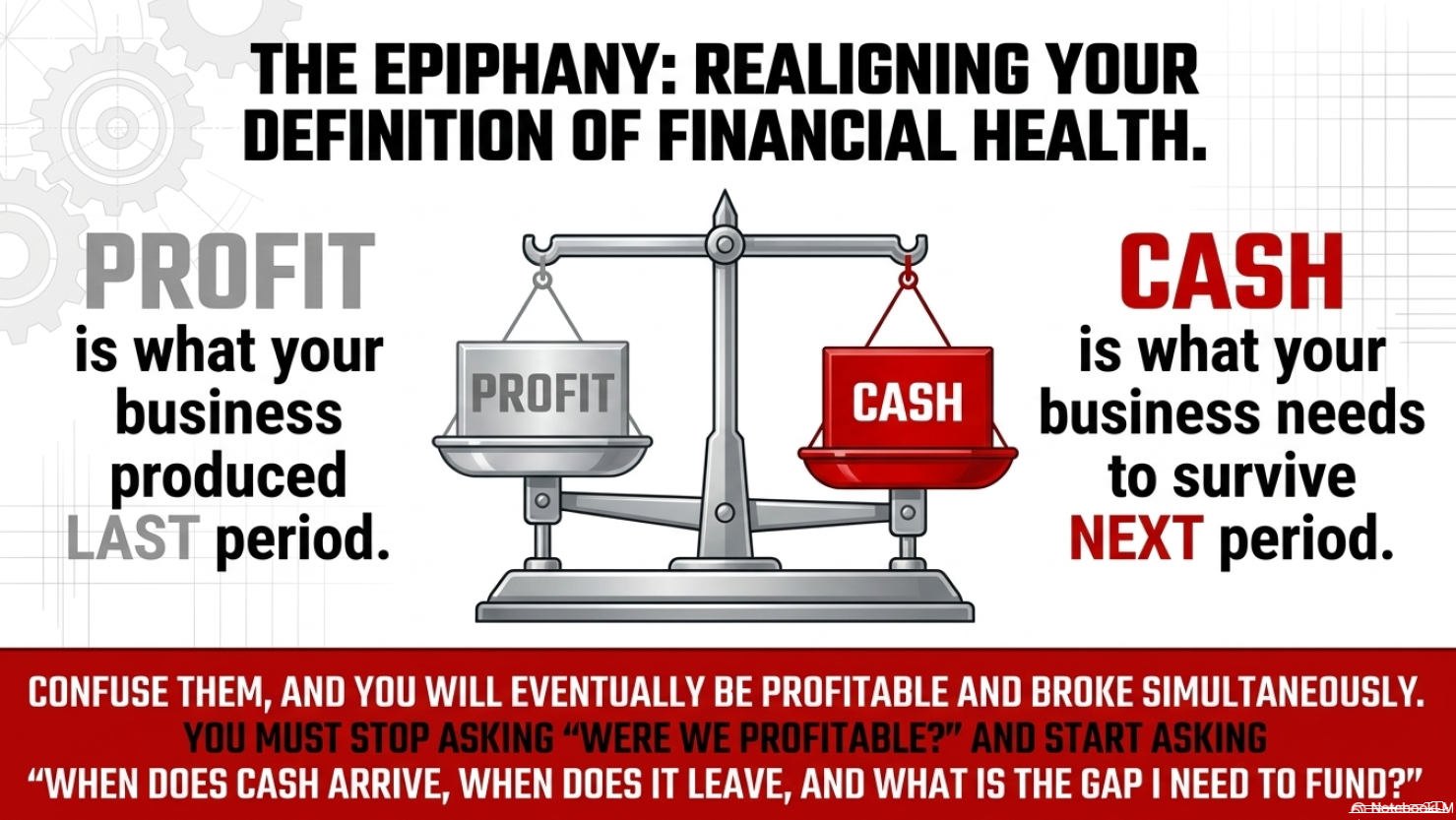
What Gap I Need to Fund?
That is what Financial Intelligence actually buys. Not a spreadsheet. Not a dashboard. Clarity. And from clarity: decisions. And from decisions that are grounded in structural reality rather than gut-feel optimism: a business that is profitable on paper and healthy in practice.
Both at the same time. By design.
The only question is whether you’re ready to build that architecture now, or whether you’ll wait for the next late payment to make the decision for you.
What Comes Next
Now you can see exactly where the structural gap lives. Seeing it and closing it are two different disciplines.
Book your complimentary Discovery Session at effecta.com.au — we’ll run the Triangular Diagnostic across your Financial Intelligence pillar and identify the Primary Constraint that’s costing your business the most right now. No pitch. No pressure. Just clarity.
Frequently Asked Questions
Q: My accountant sends me monthly reports. Isn’t that sufficient financial visibility?
Monthly reports are retrospective — they describe what happened in the previous period using accounting conventions, not cash reality. For a trades business where cash timing is the primary operational risk, you need forward-facing visibility: where does cash arrive, when, and in what amounts relative to your outgoings over the next 13 weeks? That is a different instrument to a monthly P&L or balance sheet, and most accountants don’t produce it unless it’s specifically requested and structured. The 13-week rolling cash forecast fills this gap and takes less time to maintain than most owners expect. It also tends to change how owners make decisions — permanently.
Q: If I’m growing and profitable, shouldn’t working capital sort itself out over time?
Growth with an unmanaged Cash Conversion Cycle typically makes working capital requirements worse, not better. As revenue increases, the dollar value tied up in outstanding receivables increases proportionally. A business at $2M with a 60-day debtor cycle has $330K locked in receivables. At $4M with the same debtor cycle, it’s $660K. The revenue doubled. The locked capital doubled with it. Without structural changes to CCC and receivables management, growth is scaling the problem. The fix must precede — or at minimum accompany — the growth, not follow it.
Q: What’s the single first thing I should do if I think my business has this problem?
Calculate your current debtor days — the average number of days from invoice issued to cash received. Take the total value of outstanding invoices, divide by your average daily revenue, and you have the number. If it’s above 45 for a trades business, you have a structural receivables opportunity that is probably worth between $50,000 and $200,000 in freed working capital, depending on your revenue size. That’s the number that tells you how big the gap is. From there, you can size the fix and sequence the work. Start with the calculation. Everything else follows from knowing the actual number rather than assuming it.
Vladan Nikolic is the Founder of Effecta Consulting. Effecta works with Australian SME trades businesses to diagnose and rebuild across the three pillars of the Triangular Advantage OS: Human Capital & Leadership, Systems & Processes, and Financial Intelligence.
© 2026 Vladan Nikolic / Effecta Consulting — effecta.com.au